Ch 36: Special Relativity
Knight Calc - Physics for Scientists and Engineers 5th Edition
Knight Calc5th EditionPhysics for Scientists and EngineersISBN: 9780137344796Not the one you use?Change textbook
Chapter 36, Problem 36

What are the rest energy, the kinetic energy, and the total energy of a 1.0 g particle with a speed of 0.80c?

Verified step by step guidance
1
Step 1: Start by calculating the rest energy of the particle using Einstein's equation for rest energy: E_r = m c^2, where m is the mass of the particle (1.0 g = 0.001 kg) and c is the speed of light (approximately 3.0 imes 10^8 \(\text{ m/s}\)).
Step 2: Calculate the relativistic factor \(\text{γ}\) using the formula \(\text{γ}\) = rac{1}{\(\text{√}\)(1 - v^2/c^2)}, where v is the speed of the particle (0.80c). Substitute the values to find \(\text{γ}\).
Step 3: Use the relativistic total energy formula E_t = \(\text{γ}\) m c^2 to calculate the total energy of the particle. Substitute the values of \(\text{γ}\), m, and c.
Step 4: Determine the kinetic energy of the particle using the relationship K = E_t - E_r, where E_t is the total energy and E_r is the rest energy. Substitute the values to find K.
Step 5: Summarize the results: the rest energy, kinetic energy, and total energy of the particle are now determined. Ensure all units are consistent (e.g., joules) and verify the calculations for accuracy.

Verified video answer for a similar problem:

This video solution was recommended by our tutors as helpful for the problem above.
Was this helpful?

Key Concepts

Here are the essential concepts you must grasp in order to answer the question correctly.

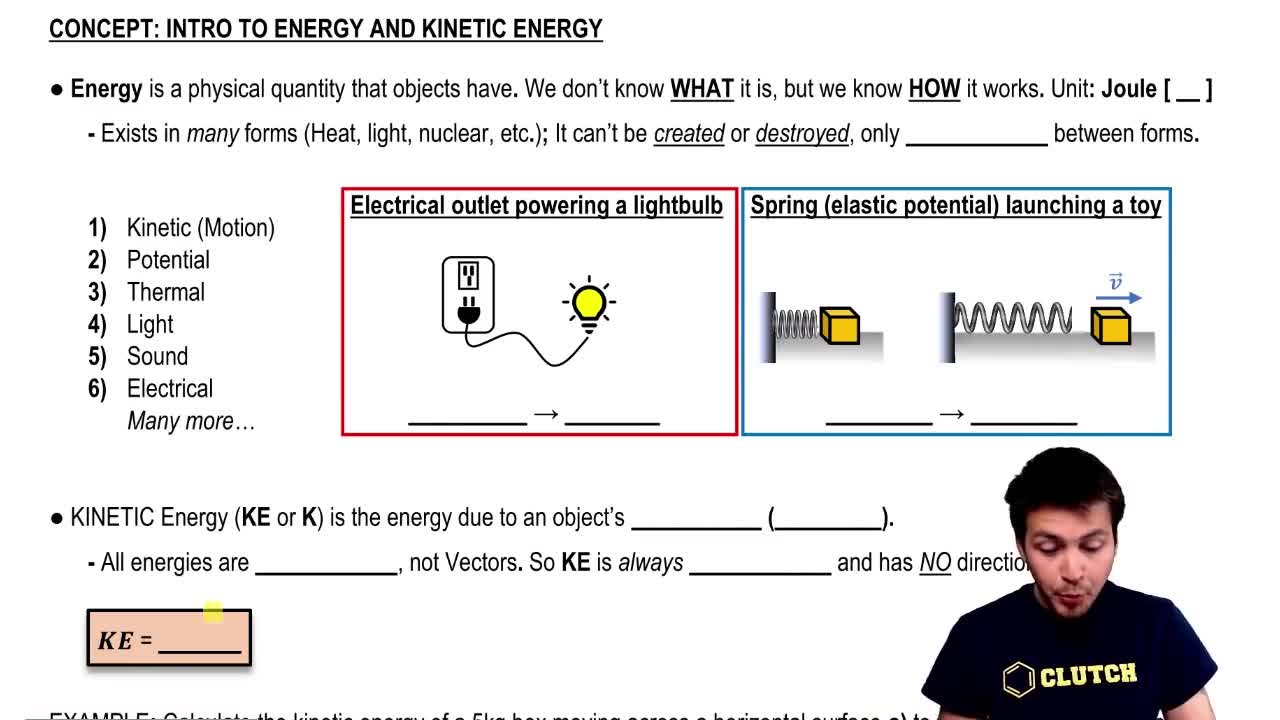
Rest Energy

Rest energy is the energy contained in an object due to its mass when it is at rest, described by Einstein's famous equation E=mc². For a particle with mass m, its rest energy is calculated by multiplying its mass by the square of the speed of light (c). In this case, for a 1.0 g particle, the rest energy can be determined by converting grams to kilograms and applying the equation.
Recommended video:
Guided course
04:10
Intro to Energy & Types of Energy

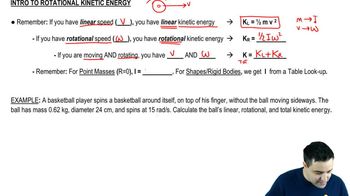
Kinetic Energy in Relativity

In the context of special relativity, the kinetic energy of an object moving at a significant fraction of the speed of light (c) is given by the formula KE = (γ - 1)mc², where γ (gamma) is the Lorentz factor. The Lorentz factor accounts for the effects of relativistic speeds and is calculated as γ = 1 / √(1 - v²/c²). For a particle moving at 0.80c, this factor must be computed to find the correct kinetic energy.
Recommended video:
Guided course
06:07
Intro to Rotational Kinetic Energy

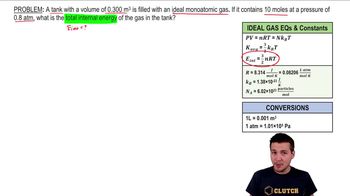
Total Energy

The total energy of a particle in relativistic physics is the sum of its rest energy and kinetic energy. It can be expressed as E_total = mc² + KE. This total energy reflects both the inherent energy due to mass and the energy due to motion, providing a complete picture of the particle's energy state at relativistic speeds.
Recommended video:
Guided course
04:54
Total Internal Energy
Related Practice
Textbook Question

A laboratory experiment shoots an electron to the left at 0.90c. What is the electron's speed, as a fraction of c, relative to a proton moving to the right at 0.90c?

103
views

Textbook Question

Two events in reference frame S occur 10 μs apart at the same point in space. The distance between the two events is 2400 m in reference frame S'. What is the velocity of S' relative to S?

60
views
Textbook Question

A quarter-pound hamburger with all the fixings has a mass of 200 g. The food energy of the hamburger (480 food calories) is 2 MJ. By what factor does the energy equivalent exceed the food energy?

81
views
Textbook Question

A distant quasar is found to be moving away from the earth at 0.80c. A galaxy closer to the earth and along the same line of sight is moving away from us at 0.20c. What is the recessional speed of the quasar, as a fraction of c, as measured by astronomers in the other galaxy?

100
views
Textbook Question

A proton is accelerated to 0.999c. By what factor does the proton's momentum exceed its Newtonian momentum?

130
views
Textbook Question

A modest supernova (the explosion of a massive star at the end of its life cycle) releases 1.5 x 10⁴⁴ J of energy in a few seconds. This is enough to outshine the entire galaxy in which it occurs. Suppose a star with the mass of our sun collides with an antimatter star of equal mass, causing complete annihilation. What is the ratio of the energy released in this star-antistar collision to the energy released in the supernova?

87
views