You are given two vectors A = -3i + 6j and B = 7i + 2j. Let Counterclockwise angles be positive. What angle does A make with the +x-axis?
Ch 01: Units, Physical Quantities & Vectors
Young & Freedman Calc14th EditionUniversity PhysicsISBN: 9780321973610Not the one you use?Change textbook
All textbooks
Young & Freedman Calc 14th Edition
Ch 01: Units, Physical Quantities & Vectors
Problem 38a
Young & Freedman Calc 14th Edition
Ch 01: Units, Physical Quantities & Vectors
Problem 38aChapter 1, Problem 38a
Given two vectors A = 4i + 7j and B = 5i - 2j, find the magnitude of each vector.
Verified step by step guidance1
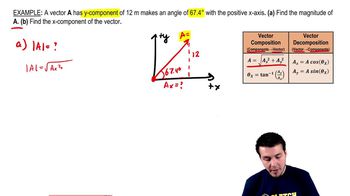
To find the magnitude of a vector, use the formula: \( |\mathbf{A}| = \sqrt{A_x^2 + A_y^2} \), where \( A_x \) and \( A_y \) are the components of vector \( \mathbf{A} \).
For vector \( \mathbf{A} = 4\mathbf{i} + 7\mathbf{j} \), identify the components: \( A_x = 4 \) and \( A_y = 7 \).
Substitute the components of vector \( \mathbf{A} \) into the magnitude formula: \( |\mathbf{A}| = \sqrt{4^2 + 7^2} \).
Similarly, for vector \( \mathbf{B} = 5\mathbf{i} - 2\mathbf{j} \), identify the components: \( B_x = 5 \) and \( B_y = -2 \).
Substitute the components of vector \( \mathbf{B} \) into the magnitude formula: \( |\mathbf{B}| = \sqrt{5^2 + (-2)^2} \).

Verified video answer for a similar problem:
This video solution was recommended by our tutors as helpful for the problem above.
Video duration:
1mWas this helpful?
Key Concepts
Here are the essential concepts you must grasp in order to answer the question correctly.
Vector Magnitude
The magnitude of a vector is a measure of its length and is calculated using the Pythagorean theorem. For a vector A = ai + bj, the magnitude is given by |A| = √(a² + b²). This formula helps determine the size of the vector in the coordinate plane.
Recommended video:
Guided course
Calculating Magnitude & Components of a Vector
Vector Components
Vectors are represented by components along the coordinate axes, typically denoted as i and j for the x and y axes, respectively. Understanding vector components is crucial for calculating vector magnitude and performing operations like addition or subtraction.
Recommended video:
Guided course
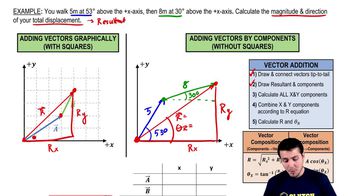
Vector Addition By Components
Pythagorean Theorem
The Pythagorean theorem is a fundamental principle in geometry that relates the lengths of the sides of a right triangle. It states that in a right triangle, the square of the hypotenuse is equal to the sum of the squares of the other two sides, which is essential for calculating vector magnitudes.
Recommended video:
Guided course
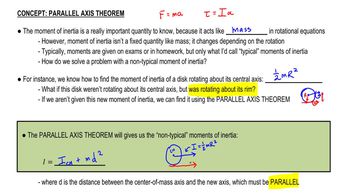
Parallel Axis Theorem
Related Practice
Textbook Question
2674
views
Textbook Question
In each case, find the x- and y- components of vector A: A = 11.2j - 9.91i
3083
views
Textbook Question
Vector A is 2.80 cm long and is 60.0° above the x-axis in the first quadrant. Vector B is 1.90 cm long and is 60.0° below the x-axis in the fourth quadrant (Fig. E1.35). Use components to find the magnitude and direction of A - B In each case, sketch the vector addition or subtraction and show that your numerical answers are in qualitative agreement with your sketch.
6307
views
1
comments
Textbook Question
Find the magnitude and direction of the vector represented by the following pairs of components: Ax = −8.60 cm, Ay = 5.20 cm
3433
views
Textbook Question
Given two vectors A = -2i + 3j + 4k and B = 3.00î + 1.00ĵ − 3.00k, find the magnitude of each vector.
3094
views
Textbook Question
Find the scalar product of the vectors A and B given in Exercise 1.38.
1915
views