
Ch 16: Sound & Hearing
Young & Freedman Calc - University Physics 14th Edition
Young & Freedman Calc14th EditionUniversity PhysicsISBN: 9780321973610Not the one you use?Change textbook
Chapter 16, Problem 19a

For a person with normal hearing, the faintest sound that can be heard at a frequency of 400 Hz has a pressure amplitude of about 6.0 × 10⁻⁵ Pa. Calculate the intensity.

Verified step by step guidance
1
Step 1: Understand the relationship between sound intensity and pressure amplitude. The intensity of a sound wave is related to the square of its pressure amplitude.
Step 2: Use the formula for sound intensity: \( I = \frac{p^2}{2 \rho v} \), where \( I \) is the intensity, \( p \) is the pressure amplitude, \( \rho \) is the density of air (approximately 1.21 kg/m³ at room temperature), and \( v \) is the speed of sound in air (approximately 343 m/s at room temperature).
Step 3: Substitute the given pressure amplitude \( p = 6.0 \times 10^{-5} \) Pa into the formula.
Step 4: Substitute the values for \( \rho \) and \( v \) into the formula. Use \( \rho = 1.21 \) kg/m³ and \( v = 343 \) m/s.
Step 5: Calculate the intensity \( I \) using the substituted values. Remember that the intensity is proportional to the square of the pressure amplitude, so ensure to square the pressure amplitude in your calculation.

Verified video answer for a similar problem:

This video solution was recommended by our tutors as helpful for the problem above.
Video duration:
4m
Was this helpful?

Key Concepts

Here are the essential concepts you must grasp in order to answer the question correctly.

Sound Intensity

Sound intensity is the power per unit area carried by a sound wave. It is measured in watts per square meter (W/m²) and is a crucial concept for understanding how sound energy is distributed in space. Intensity is related to the amplitude of the sound wave, with higher amplitudes resulting in greater intensities.
Recommended video:
Guided course
04:25
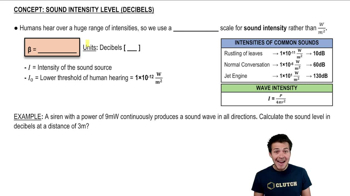
Sound Intensity Level and the Decibel Scale

Pressure Amplitude

Pressure amplitude refers to the maximum change in pressure caused by a sound wave, measured in pascals (Pa). It is a measure of the strength of the sound wave and is directly related to the intensity of the sound. In this context, a pressure amplitude of 6.0 * 10^-5 Pa is given, which is used to calculate the sound intensity.
Recommended video:
Guided course
17:04
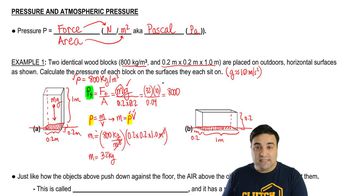
Pressure and Atmospheric Pressure

Relationship Between Intensity and Amplitude

The intensity of a sound wave is proportional to the square of its pressure amplitude. This relationship is crucial for calculating intensity from a given amplitude. Mathematically, intensity (I) can be expressed as I = (p^2)/(2ρv), where p is the pressure amplitude, ρ is the density of the medium, and v is the speed of sound in the medium.
Recommended video:
Guided course
03:43
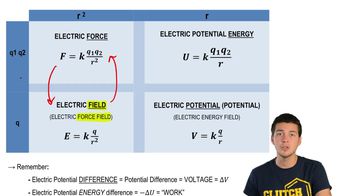
Relationships Between Force, Field, Energy, Potential
Related Practice
Textbook Question

Standing sound waves are produced in a pipe that is 1.20 m long. For the fundamental and first two overtones, determine the locations along the pipe (measured from the left end) of the displacement nodes and the pressure nodes if the pipe is closed at the left end and open at the right end.

2985
views
Textbook Question

Standing sound waves are produced in a pipe that is 1.20 m long. For the fundamental and first two overtones, determine the locations along the pipe (measured from the left end) of the displacement nodes and the pressure nodes if (a) the pipe is open at both ends

1647
views
Textbook Question

You live on a busy street, but as a music lover, you want to reduce the traffic noise. If you install special soundreflecting windows that reduce the sound intensity level (in dB) by 30 dB, by what fraction have you lowered the sound intensity (in W/m2)?

1877
views
1
rank
Textbook Question

A baby's mouth is 30 cm from her father's ear and 1.50 m from her mother's ear. What is the difference between the sound intensity levels heard by the father and by the mother?

1951
views
Textbook Question

You live on a busy street, but as a music lover, you want to reduce the traffic noise. If, instead, you reduce the intensity by half, what change (in dB) do you make in the sound intensity level?

1785
views
1
rank
Textbook Question

A sound wave in air at 20°C has a frequency of 320 Hz and a displacement amplitude of 5.00 × 10⁻³ mm. For this sound wave calculate the pressure amplitude (in Pa)

2491
views