
Ch 27: Magnetic Field and Magnetic Forces
Young & Freedman Calc - University Physics 15th Edition
Young & Freedman Calc15th EditionUniversity PhysicsISBN: 9780135159552Not the one you use?Change textbook
Chapter 27, Problem 45

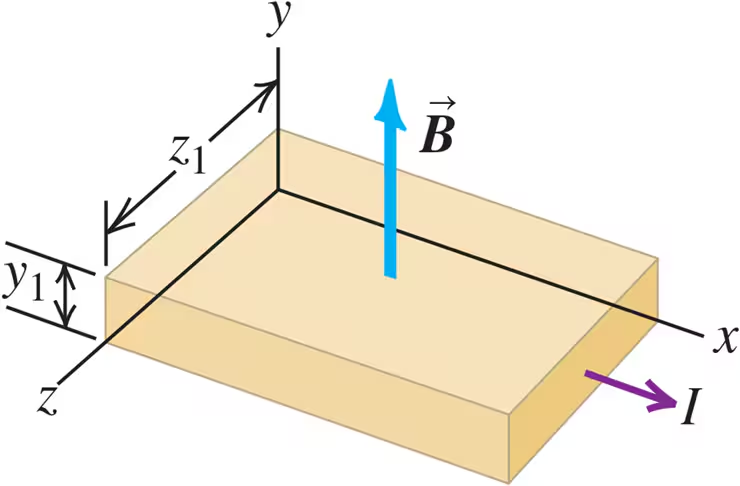
Figure E27.49 shows a portion of a silver ribbon with z1 = 11.8 mm and y1 = 0.23 mm, carrying a current of 120 A in the +x-direction. The ribbon lies in a uniform magnetic field, in the y-direction, with magnitude 0.95 T. Apply the simplified model of the Hall effect presented in Section 27.9. If there are 5.85 x 1028 free electrons per cubic meter, find (a) the magnitude of the drift velocity of the electrons in the x-direction; (b) the magnitude and direction of the electric field in the z-direction due to the Hall effect; (c) the Hall emf.

Verified step by step guidance
1
Step 1: To find the magnitude of the drift velocity of the electrons in the x-direction, use the formula for current density \( J = n e v_d \), where \( J \) is the current density, \( n \) is the number of free electrons per unit volume, \( e \) is the charge of an electron, and \( v_d \) is the drift velocity. First, calculate the current density \( J \) using \( J = \frac{I}{A} \), where \( I \) is the current and \( A \) is the cross-sectional area of the ribbon. The area \( A \) can be found using \( A = z_1 \times y_1 \).
Step 2: Once you have the current density \( J \), rearrange the formula \( J = n e v_d \) to solve for the drift velocity \( v_d \): \( v_d = \frac{J}{n e} \). Substitute the values for \( J \), \( n \), and \( e \) to find \( v_d \).
Step 3: To find the magnitude and direction of the electric field in the z-direction due to the Hall effect, use the Hall effect formula \( E = v_d B \), where \( E \) is the electric field, \( v_d \) is the drift velocity, and \( B \) is the magnetic field. The direction of the electric field is determined by the direction of the magnetic force on the electrons, which is perpendicular to both the current direction and the magnetic field direction.
Step 4: Calculate the Hall emf using the formula \( \text{emf} = E \times z_1 \), where \( E \) is the electric field found in the previous step and \( z_1 \) is the width of the ribbon in the z-direction.
Step 5: Review the direction of the electric field and the Hall emf. The direction of the electric field is in the negative z-direction because the electrons experience a force opposite to the conventional current direction due to the magnetic field. The Hall emf is also in the negative z-direction.

Verified video answer for a similar problem:

This video solution was recommended by our tutors as helpful for the problem above.
Was this helpful?

Key Concepts

Here are the essential concepts you must grasp in order to answer the question correctly.

Hall Effect

The Hall effect occurs when a current-carrying conductor is placed in a magnetic field, resulting in a voltage (Hall voltage) across the conductor perpendicular to both the current and the magnetic field. This effect is used to measure the magnetic field strength and the charge carrier density in the conductor.
Recommended video:
Guided course
07:40
The Doppler Effect

Drift Velocity

Drift velocity is the average velocity of charge carriers, such as electrons, due to an electric field in a conductor. It is calculated using the formula v_d = I / (nAe), where I is the current, n is the charge carrier density, A is the cross-sectional area, and e is the charge of an electron. Drift velocity is crucial for understanding current flow in materials.
Recommended video:
Guided course
7:27
Escape Velocity

Magnetic Field Interaction

When a conductor with current is placed in a magnetic field, the Lorentz force acts on the moving charges, causing them to deflect. This interaction is fundamental to the Hall effect, where the magnetic field causes a separation of charges, leading to an electric field perpendicular to the current and magnetic field. Understanding this interaction is key to analyzing the Hall effect.
Recommended video:
Guided course
05:30
Magnetic Fields and Magnetic Dipoles
Related Practice
Textbook Question

A straight, 2.5 m wire carries a typical household current of 1.5 A (in one direction) at a location where the earth's magnetic field is 0.55 gauss from south to north. Find the magnitude and direction of the force that our planet's magnetic field exerts on this wire if it is oriented so that the current in it is running (a) from west to east, (b) vertically upward, (c) from north to south. (d) Is the magnetic force ever large enough to cause significant effects under normal household conditions?

2863
views
Textbook Question

A straight, vertical wire carries a current of 2.60 A downward in a region between the poles of a large superconducting electromagnet, where the magnetic field has magnitude B = 0.588 T and is horizontal. What are the magnitude and direction of the magnetic force on a 1.00 cm section of the wire that is in this uniform magnetic field, if the magnetic field direction is (a) east?

2975
views
Textbook Question

A thin, 50.0 cm long metal bar with mass 750 g rests on, but is not attached to, two metallic supports in a uniform 0.450 T magnetic field, as shown in Fig. E27.37. A battery and a 25.0 Ω resistor in series are connected to the supports. (a) What is the highest voltage the battery can have without breaking the circuit at the supports? (b) The battery voltage has the maximum value calculated in part (a). If the resistor suddenly gets partially short-circuited, decreasing its resistance to 2.00 Ω, find the initial acceleration of the bar.

2826
views
2
rank