

Ch 30: Inductance
Young & Freedman Calc - University Physics 15th Edition
Young & Freedman Calc15th EditionUniversity PhysicsISBN: 9780135159552Not the one you use?Change textbook
Chapter 30, Problem 7b

At the instant when the current in an inductor is increasing at a rate of 0.0640 A/s, the magnitude of the self-induced emf is 0.0160 V. If the inductor is a solenoid with 400 turns, what is the average magnetic flux through each turn when the current is 0.720 A?

Verified step by step guidance
1
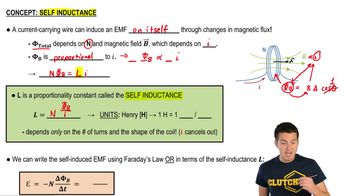
First, recall the formula for the self-induced emf in an inductor: \( \text{emf} = -L \frac{dI}{dt} \), where \( L \) is the inductance, \( \frac{dI}{dt} \) is the rate of change of current, and \( \text{emf} \) is the electromotive force.
Given that the self-induced emf is 0.0160 V and the rate of change of current is 0.0640 A/s, use the formula to solve for the inductance \( L \): \( L = \frac{\text{emf}}{\frac{dI}{dt}} \). Substitute the given values to find \( L \).
Next, use the relationship between magnetic flux \( \Phi \), inductance \( L \), and current \( I \) in a solenoid: \( L = N \frac{\Phi}{I} \), where \( N \) is the number of turns. Rearrange this formula to solve for the magnetic flux \( \Phi \): \( \Phi = \frac{L \cdot I}{N} \).
Substitute the values for \( L \) (calculated in the previous step), \( I = 0.720 \) A, and \( N = 400 \) turns into the formula to find the average magnetic flux \( \Phi \) through each turn.
Ensure all units are consistent and perform the calculation to find the average magnetic flux through each turn of the solenoid.

Verified video answer for a similar problem:

This video solution was recommended by our tutors as helpful for the problem above.
Video duration:
2m
Was this helpful?

Key Concepts

Here are the essential concepts you must grasp in order to answer the question correctly.

Inductance and Self-Induced EMF

Inductance is a property of an electrical conductor, such as a solenoid, that causes it to oppose changes in current. The self-induced electromotive force (emf) is generated when the current through the inductor changes, according to Faraday's law of induction. The emf is proportional to the rate of change of current and the inductance of the coil, given by the formula emf = -L * (di/dt), where L is the inductance.
Recommended video:
Guided course
07:58
Self Inductance

Magnetic Flux

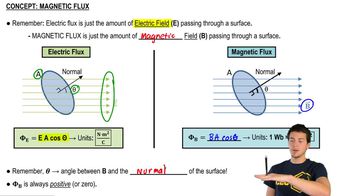
Magnetic flux through a surface is the product of the magnetic field and the area it penetrates, perpendicular to the field. It is a measure of the quantity of magnetism, taking into account the strength and extent of a magnetic field. For a solenoid, the magnetic flux through each turn is given by the formula Φ = B * A, where B is the magnetic field and A is the cross-sectional area of the solenoid.
Recommended video:
Guided course
04:52
Magnetic Flux

Solenoid and Its Magnetic Field

A solenoid is a coil of wire designed to create a magnetic field when an electric current passes through it. The magnetic field inside a long solenoid is uniform and parallel to the axis of the solenoid, and its strength is given by B = μ₀ * (N/L) * I, where μ₀ is the permeability of free space, N is the number of turns, L is the length of the solenoid, and I is the current. This field is crucial for calculating the magnetic flux through each turn.
Recommended video:
Guided course
13:54
Magnetic Field Produced by Loops and Solenoids
Related Practice
Textbook Question

The inductor shown in Fig. E30.11 has inductance 0.260 H and carries a current in the direction shown. The current is changing at a constant rate. The potential between points a and b is Vab = 1.04 V, with point a at higher potential. Is the current increasing or decreasing?

2464
views
Textbook Question

At the instant when the current in an inductor is increasing at a rate of 0.0640 A/s, the magnitude of the self-induced emf is 0.0160 V. What is the inductance of the inductor?

2031
views
Textbook Question

Two coils have mutual inductance M = 3.25 × 10⁻⁴ H. The current i1 in the first coil increases at a uniform rate of 830 A/s. What is the magnitude of the induced emf in the second coil? Is it constant?

1706
views
Textbook Question

When the current in a toroidal solenoid is changing at a rate of 0.0260 A/s, the magnitude of the induced emf is 12.6 mV. When the current equals 1.40 A, the average flux through each turn of the solenoid is 0.00285 Wb. How many turns does the solenoid have?

2683
views
Textbook Question

Inductance of a Solenoid. A metallic laboratory spring is typically 5.00 cm long and 0.150 cm in diameter and has 50 coils. If you connect such a spring in an electric circuit, how much self-inductance must you include for it if you model it as an ideal solenoid?

2241
views
Textbook Question

A 2.50-mH toroidal solenoid has an average radius of 6.00 cm and a cross-sectional area of 2.00 cm2. How many coils does it have? (Make the same assumption as in Example 30.3.)

2544
views