
Ch 34: Geometric Optics
Young & Freedman Calc - University Physics 15th Edition
Young & Freedman Calc15th EditionUniversity PhysicsISBN: 9780135159552Not the one you use?Change textbook
Chapter 33, Problem 38

A lensmaker wants to make a magnifying glass from glass that has an index of refraction n = 1.55 and a focal length of 20.0 cm. If the two surfaces of the lens are to have equal radii, what should that radius be?

Verified step by step guidance
1
Start with the lensmaker's equation: 1f = (n - 1) * ( 1R - 1R' ), where f is the focal length, n is the index of refraction, and R and R' are the radii of curvature of the two surfaces.
Since the two surfaces of the lens are to have equal radii, set R = -R' (the negative sign accounts for the opposite curvature directions). Substitute this into the lensmaker's equation: 1f = (n - 1) * ( 1R - 1-R ).
Simplify the equation: 1f = (n - 1) * ( 1R + 1R ) = (n - 1) * 2R.
Rearrange the equation to solve for R: R = 2f * (n - 1).
Substitute the given values: f = 20.0 cm and n = 1.55. This will allow you to calculate the radius R.

Verified video answer for a similar problem:

This video solution was recommended by our tutors as helpful for the problem above.
Video duration:
3m
Was this helpful?

Key Concepts

Here are the essential concepts you must grasp in order to answer the question correctly.

Lensmaker's Equation

The Lensmaker's Equation relates the focal length of a lens to the radii of curvature of its two surfaces and the refractive index of the material. It is expressed as 1/f = (n - 1) * (1/R1 - 1/R2), where f is the focal length, n is the refractive index, and R1 and R2 are the radii of curvature. For a lens with equal radii, R1 = R2 = R, simplifying the equation significantly.
Recommended video:
05:38
Lens Maker Equation

Index of Refraction

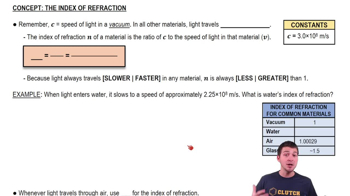
The index of refraction (n) is a dimensionless number that describes how light propagates through a medium. It is defined as the ratio of the speed of light in a vacuum to the speed of light in the medium. A higher index indicates that light travels slower in that medium, affecting how light bends when entering or exiting the lens, which is crucial for determining the lens's focal length.
Recommended video:
Guided course
03:46
Index of Refraction

Focal Length

The focal length of a lens is the distance from the lens to the focal point, where parallel rays of light converge after passing through the lens. It is a key parameter in lens design, influencing the magnification and image formation. In this scenario, the focal length is given as 20.0 cm, which is essential for calculating the required radius of curvature for the lens surfaces.
Recommended video:
Guided course
10:54
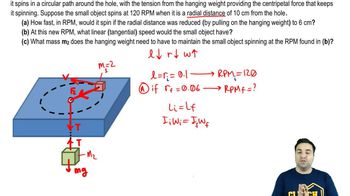
Spinning on a string of variable length
Related Practice
Textbook Question

A 1.20 cm tall object is 50.0 cm to the left of a converging lens of focal length 40.0 cm. A second converging lens, this one having a focal length of 60.0 cm, is located 300.0 cm to the right of the first lens along the same optic axis. Find the location and height of the image (call it I1) formed by the lens with a focal length of 40.0 cm.

234
views
Textbook Question

An object is 16.0 cm to the left of a lens. The lens forms an image 36.0 cm to the right of the lens. Draw a principal-ray diagram.

1575
views
Textbook Question

A converging lens with a focal length of 70.0 cm forms an image of a 3.20 cm tall real object that is to the left of the lens. The image is 4.50 cm tall and inverted. Where are the object and image located in relation to the lens? Is the image real or virtual?

2013
views
Textbook Question

An object is 16.0 cm to the left of a lens. The lens forms an image 36.0 cm to the right of the lens. If the object is 8.00 mm tall, how tall is the image? Is it erect or inverted?

2170
views
Textbook Question

A lens forms an of an object. The object is 16.0 cm from the lens. The is 12.0 cm from the lens on the same side as the object. What is the focal length of the lens? Is the lens converging or diverging?

2007
views
Textbook Question

A converging lens with a focal length of 9.00 cm forms an image of a 4.00 mm tall real object that is to the left of the lens. The image is 1.30 cm tall and erect. Where are the object and image located? Is the image real or virtual?

1912
views