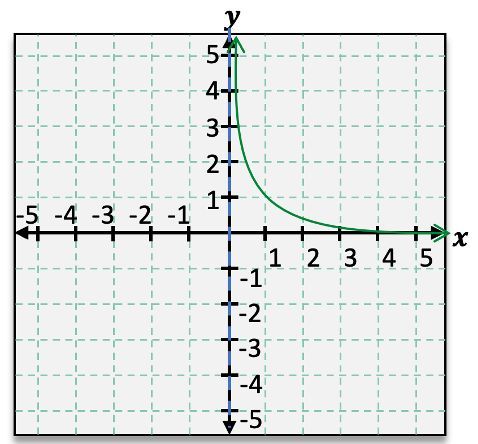
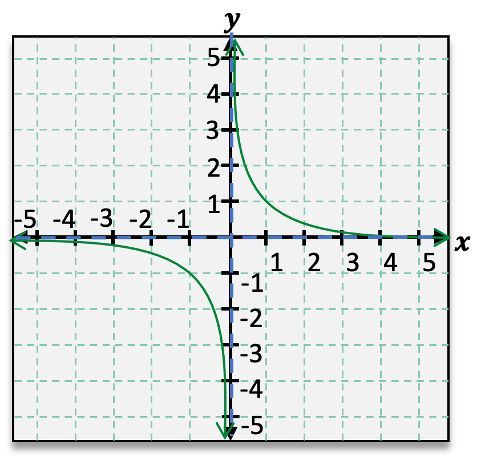
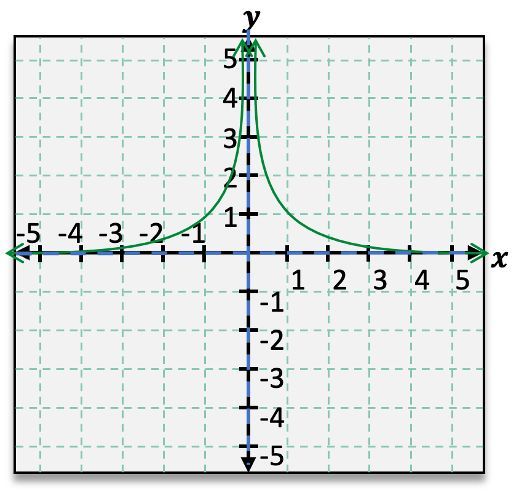
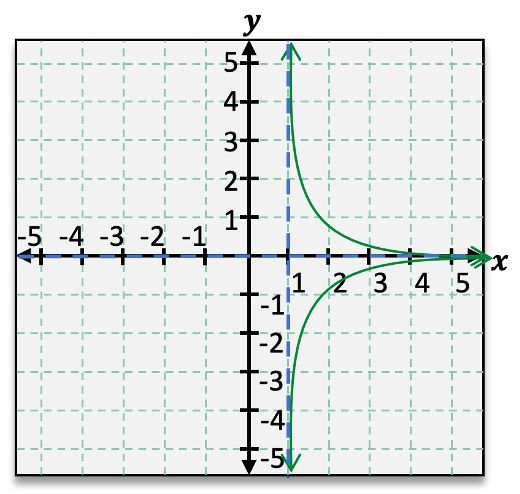
Based only on the vertical asymptotes, which of the following graphs could be the graph of the given function?
Table of contents
- 0. Fundamental Concepts of Algebra3h 32m
- 1. Equations and Inequalities3h 27m
- 2. Graphs1h 43m
- 3. Functions & Graphs2h 17m
- 4. Polynomial Functions1h 54m
- 5. Rational Functions1h 23m
- 6. Exponential and Logarithmic Functions2h 28m
- 7. Measuring Angles40m
- 8. Trigonometric Functions on Right Triangles2h 5m
- 9. Unit Circle1h 19m
- 10. Graphing Trigonometric Functions1h 19m
- 11. Inverse Trigonometric Functions and Basic Trig Equations1h 41m
- 12. Trigonometric Identities 2h 34m
- 13. Non-Right Triangles1h 38m
- 14. Vectors2h 25m
- 15. Polar Equations2h 5m
- 16. Parametric Equations1h 6m
- 17. Graphing Complex Numbers1h 7m
- 18. Systems of Equations and Matrices3h 6m
- 19. Conic Sections2h 36m
- 20. Sequences, Series & Induction1h 15m
- 21. Combinatorics and Probability1h 45m
- 22. Limits & Continuity1h 49m
- 23. Intro to Derivatives & Area Under the Curve2h 9m
5. Rational Functions
Asymptotes
Multiple Choice
Sketch the graph of the function f(x)=x21. Identify the asymptotes on the graph.
A
Vertical Asymptote: x=0, Horizontal Asymptote: None
B
Vertical Asymptote: x=0, Horizontal Asymptote: y=0
C
Vertical Asymptote: x=0, Horizontal Asymptote: y=0
D
Vertical Asymptote: x=1 , Horizontal Asymptote: y=0
0 Comments
Verified step by step guidance1
The function given is \( f(x) = \frac{1}{x^2} \). This is a rational function where the numerator is a constant and the denominator is a quadratic expression.
Identify the vertical asymptote by setting the denominator equal to zero. Since \( x^2 = 0 \) when \( x = 0 \), the vertical asymptote is at \( x = 0 \).
Determine the horizontal asymptote by analyzing the behavior of \( f(x) \) as \( x \) approaches infinity. As \( x \to \infty \) or \( x \to -\infty \), \( f(x) \to 0 \). Therefore, the horizontal asymptote is \( y = 0 \).
Sketch the graph by plotting key points and drawing the asymptotes. The graph will approach the vertical asymptote at \( x = 0 \) and the horizontal asymptote at \( y = 0 \).
Observe the symmetry of the function. Since \( f(x) = \frac{1}{x^2} \) is an even function, the graph is symmetric about the y-axis.
Related Videos
Related Practice
Multiple Choice
404
views
6
rank

