Skip to main content
Precalculus
My Course
Learn
Exam Prep
AI Tutor
Study Guides
Flashcards
Explore
Try the app
My Course
Learn
Exam Prep
AI Tutor
Study Guides
Flashcards
Explore
Try the app
Back
Precalculus Key Concepts and Techniques
You can tap to flip the card.
What is the effect of transformations on the graph of a function?
You can tap to flip the card.
👆
What is the effect of transformations on the graph of a function?
Transformations shift, stretch, compress, or reflect the graph of a function to produce a new graph.
Track progress
Control buttons has been changed to "navigation" mode.
1/28
Recommended videos
01:09
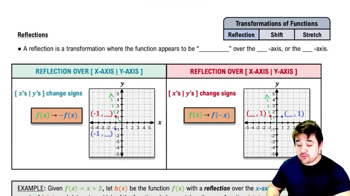
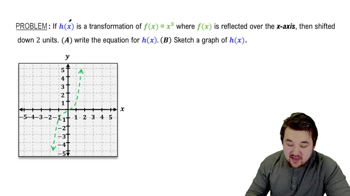
Reflections of Functions Example 1
1548
views
54
rank
5:00
Reflections of Functions
1972
views
81
rank
2:49
Graphs of Shifted & Reflected Functions Example 1
1119
views
50
rank
2
comments
Terms in this set (28)
Hide definitions
What is the effect of transformations on the graph of a function?
Transformations shift, stretch, compress, or reflect the graph of a function to produce a new graph.
How do you simplify complex numbers?
Combine like terms and use \(i^2 = -1\) to rewrite powers of
i
.
What is a radical equation?
An equation in which the variable is inside a root, such as a square root.
How do you solve rational equations?
Find a common denominator, multiply both sides to clear fractions, then solve the resulting equation.
What is an absolute value equation?
An equation involving the absolute value function, which measures distance from zero.
How do you solve quadratic equations using multiple techniques?
Use factoring, completing the square, quadratic formula, or graphing.
How do you find the vertex of a quadratic function?
Use the formula \(x = -\frac{b}{2a}\) to find the x-coordinate, then substitute to find y.
What are the properties of logarithms used to solve equations?
Properties include product, quotient, and power rules to simplify and solve logarithmic equations.
How do you solve polynomial equations?
Factor the polynomial or use the Rational Root Theorem and synthetic division.
What is the general shape of exponential functions?
Exponential functions have a curve that increases or decreases rapidly, depending on the base.
How do you find zeros of rational functions?
Set the numerator equal to zero and solve for the variable.
What are vertical asymptotes in rational functions?
Vertical lines where the function is undefined, found by setting the denominator equal to zero.
What is a composite function?
A function formed by applying one function to the result of another, denoted as \((f \circ g)(x) = f(g(x))\).
How do you find the inverse of a function?
Swap the roles of x and y in the equation and solve for y.
What is function notation?
A way to denote functions using \(f(x)\) to represent the output for input x.
How do you determine the domain of a function?
Find all input values for which the function is defined.
How do you determine the range of a function?
Find all possible output values of the function.
What does it mean for a function to be increasing or decreasing?
Increasing means output values rise as input increases; decreasing means output values fall.
How do you find the maximum or minimum of a function?
Identify the highest or lowest point on the graph, often the vertex for quadratics.
What is the difference quotient?
A formula \(\frac{f(x+h)-f(x)}{h}\) used to find the average rate of change of a function.
What types of equations are quadratic in form?
Equations that can be rewritten to resemble a quadratic equation, often by substitution.
How do you solve absolute value inequalities?
Split into two inequalities and solve each separately.
What is the role of technology in precalculus?
Technology helps graph functions, solve equations, and visualize concepts.
What are rational expressions?
Expressions that are ratios of polynomials.
How do you simplify rational expressions?
Factor numerator and denominator and cancel common factors.
What is the significance of vertical asymptotes in graphing rational functions?
They indicate values where the function grows without bound or is undefined.
How do you sketch polynomial functions?
Identify zeros, end behavior, and turning points to draw the graph.
What is the domain restriction for radical functions?
The radicand must be greater than or equal to zero for even roots.
 BackBack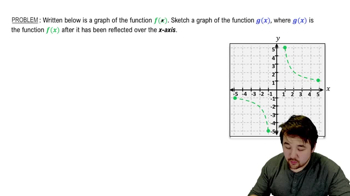
 01:09
01:09