Skip to main content
Precalculus
My Course
Learn
Exam Prep
AI Tutor
Study Guides
Flashcards
Explore
Try the app
My Course
Learn
Exam Prep
AI Tutor
Study Guides
Flashcards
Explore
Try the app
Back
Precalculus Midterm 2 Practice Flashcards
You can tap to flip the card.
Write the quadratic function q(x) = x² − 10x + 3 in standard form.
You can tap to flip the card.
👆
Write the quadratic function q(x) = x² − 10x + 3 in standard form.
Standard form is \(a(x-h)^2+k\). Complete the square to get \((x-5)^2-22\).
Track progress
Control buttons has been changed to "navigation" mode.
1/14
Recommended videos
07:42
Properties of Parabolas
3296
views
96
rank
1
comments
08:07
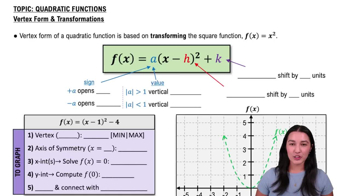
Vertex Form
1868
views
75
rank
07:11
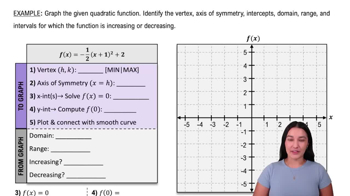
Example 1
1515
views
49
rank
3
comments
Terms in this set (14)
Hide definitions
Write the quadratic function q(x) = x² − 10x + 3 in standard form.
Standard form is \(a(x-h)^2+k\). Complete the square to get \((x-5)^2-22\).
Solve the inequality 3x + 5 / (x + 9) ≥ 0 in interval form.
Find zeros and undefined points: numerator zero at
x = -5/3
, denominator zero at
x = -9
. Test intervals to get solution
(-9, -5/3]
.
Solve the inequality x² + 3x − 4 ≤ 0 in interval form.
Factor as \((x+4)(x-1)\). Inequality holds between roots, so solution is
[-4, 1]
.
Find the vertex of q(x) = x² − 6x − 7.
Vertex form: complete the square or use \(h=-\frac{b}{2a}\). Vertex is
(3, -16)
.
Find the x-intercepts of q(x) = x² − 6x − 7.
Solve \(x^2-6x-7=0\). Roots are
x = 7
and
x = -1
. Intercepts are points (7,0) and (-1,0).
Calculate the horizontal asymptote(s) of R(x) = (x + 213)(x + 51) / (x + 20)(x − 12).
Degrees of numerator and denominator are equal. Horizontal asymptote is ratio of leading coefficients:
y = 1
.
Calculate the vertical asymptote(s) of R(x) = (x + 213)(x + 51) / (x + 20)(x − 12).
Vertical asymptotes occur where denominator is zero:
x = -20
and
x = 12
.
Explain what R(−10,000) is approximately equal to without calculating.
For large |x|, R(x) ≈ ratio of leading terms, so R(−10,000) ≈
1
.
Why is the horizontal asymptote of h(x) = (666x − 5.6) / (x² + 1) equal to y = 0?
Degree of denominator (2) is greater than numerator (1), so horizontal asymptote is
y = 0
.
Find the standard form of a parabola with vertex (1,1) passing through (2,2).
Use vertex form \(y=a(x-1)^2+1\). Substitute (2,2) to find
a=1
. Equation: \(y=(x-1)^2+1\).
Calculate the base b that gives maximum area for A(b) = 26b − b².
Maximum at vertex: \(b=\frac{-26}{-2} = 13\).
Calculate the maximum area for A(b) = 26b − b² when b = 13.
Substitute b=13: \(A(13)=26(13)-13^2=169\).
Explain why the calculated area at b=13 is a maximum.
The quadratic has a negative leading coefficient (
-1
), so the parabola opens downward, making the vertex a maximum.
Describe a quadratic polynomial with no x-intercepts.
A parabola that does not cross the x-axis has a
negative discriminant
and lies entirely above or below the x-axis.
 BackBack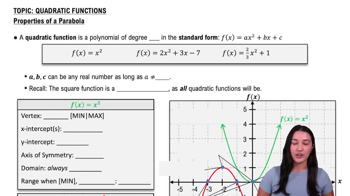
 07:42
07:42