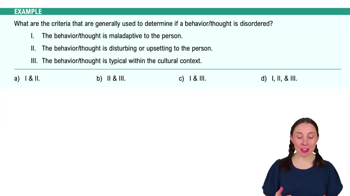
What is not a defining characteristic of antisocial personality disorder?
A lack of distress or impairment in functioning is not a defining characteristic; antisocial personality disorder is defined by maladaptive, distressing, and atypical behavior.
What is a common characteristic of all dissociative disorders?
A significant disturbance in cognition, emotion, or behavior that causes distress or impairment is common to all dissociative disorders.
Which disorder falls under the category of somatic symptom and related disorders?
Somatic symptom disorder, which involves physical complaints not fully explained by medical conditions, falls under this category.
What is a key sign of alcohol poisoning?
Impairment in functioning and distress, such as confusion or unconsciousness, are key signs of alcohol poisoning.
Which child is most likely to receive treatment for a psychological challenge?
A child whose behavior is maladaptive, distressing, and atypical within their cultural context is most likely to receive treatment.
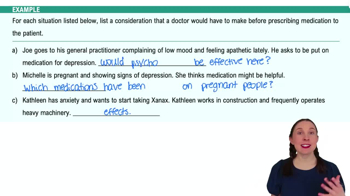
What is true concerning the use of medicine to treat a mental disorder?
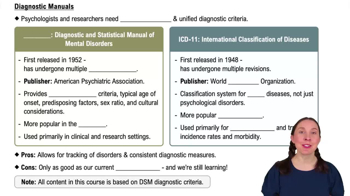
Medicine may be used as part of treatment, but diagnosis and treatment should be based on standardized criteria such as those in the DSM-5.
What is a sign of borderline personality disorder?
Maladaptive and distressing patterns of emotion and behavior are signs of borderline personality disorder.
How are mental disorders described?
Mental disorders are significant disturbances in cognition, emotion, or behavior that cause distress or impairment in functioning.
Which statement describes experiences or feelings related to anxiety?
Experiences of excessive fear, worry, or distress that impair functioning are related to anxiety.
What is a symptom of an anxiety disorder?
Excessive fear or worry that is maladaptive and causes distress or impairment is a symptom of an anxiety disorder.
What is one source of error associated with self-report inventories?
Self-report inventories may be affected by subjective bias or inaccurate reporting of symptoms.
What warning signs can be used to identify a suicidal person?
Warning signs include expressions of hopelessness, withdrawal, and significant changes in behavior or mood.
What condition causes irreversible dementia?
A condition that leads to permanent impairment in cognition and functioning, such as Alzheimer's disease, causes irreversible dementia.
Which types of children tend to get bullied?
Children whose behavior is atypical or who show signs of distress or impairment may be more likely to be bullied.
What is true of a person using early-stage dementia communication patterns?
A person with early-stage dementia may show mild impairment in communication and cognition.
Which disorder involves delayed or lacking development of theory of mind?
Autism spectrum disorder often involves delayed or lacking development of theory of mind.
Which scenario most likely requires attention from a mental health professional?
A scenario where a person exhibits maladaptive, distressing, and atypical behavior that impairs functioning requires professional attention.
Which client is most likely to be diagnosed with body dysmorphic disorder?
A client who is preoccupied with perceived defects in appearance that cause distress and impairment may be diagnosed with body dysmorphic disorder.
What is an example of retrograde amnesia?
Retrograde amnesia is the loss of memory for events that occurred before the onset of amnesia.
What is an example of a dementia-related behavior?
Impaired memory, confusion, and difficulty with daily functioning are examples of dementia-related behaviors.
What is not a common characteristic of dyslexia?
Atypical emotional disturbance is not a common characteristic; dyslexia primarily affects reading and language processing.
Which is not a type of anxiety disorder?
A disorder that does not involve excessive fear or anxiety is not a type of anxiety disorder.
Which assessment finding would best support a concern of disordered grieving?
Persistent distress and impairment in functioning following a loss support a concern of disordered grieving.
What is not a characteristic of autism spectrum disorders?
Typical development of social communication is not a characteristic; autism spectrum disorders involve deficits in social communication and interaction.
At what age does 50% of all lifetime mental ill-health begin, and 75% by what age?
50% of all lifetime mental ill-health begins by adolescence, and 75% by early adulthood.
What is not a symptom of alcoholism?
Symptoms unrelated to maladaptive alcohol use, such as typical mood fluctuations, are not symptoms of alcoholism.
Which conditions can mimic symptoms of dementia?
Medical conditions or psychological disorders that cause cognitive impairment can mimic symptoms of dementia.
What is a common symptom of the manic phase of bipolar disorder?
Elevated mood, increased energy, and impaired judgment are common symptoms of the manic phase.
What is true about patients with aphonia?
Patients with aphonia have lost the ability to speak.
What exemplifies a symptom of histrionic personality disorder?
Excessive emotionality and attention-seeking behavior exemplify histrionic personality disorder.
What is true about the inability to pass a balance test?
Impaired balance may indicate a disturbance in functioning, which can be a symptom of a psychological or neurological disorder.
What is true of post-traumatic stress disorder (PTSD)?
PTSD involves distressing symptoms following exposure to a traumatic event, causing impairment in functioning.
What is not a symptom of major depressive disorder?
Symptoms unrelated to mood disturbance, such as typical energy levels, are not symptoms of major depressive disorder.
Psychological disturbances and liver damage are side effects of which substance?
Alcohol abuse can cause psychological disturbances and liver damage.
Which type of disorder affects daily functioning without an obvious external cause?
Psychological disorders affect daily functioning without an obvious external cause.
What is a symptom of both secondary traumatic stress and PTSD?
Distressing memories and impaired functioning are symptoms of both secondary traumatic stress and PTSD.
How is chronic fatigue syndrome described?
Chronic fatigue syndrome involves persistent fatigue that impairs functioning and cannot be explained by other medical conditions.
Which factors may lead to the development of a dissociative disorder?
Significant psychological stress or trauma may contribute to the development of dissociative disorders.
 Back
Back
 01:55
01:55