Skip to main content
Psychology
My Course
Learn
Exam Prep
AI Tutor
Study Guides
Flashcards
Explore
Try the app
My Course
Learn
Exam Prep
AI Tutor
Study Guides
Flashcards
Explore
Try the app
Back
Emotion definitions
You can tap to flip the card.
Emotion
You can tap to flip the card.
👆
Emotion
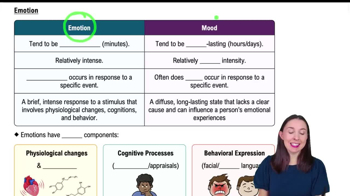
A brief, intense reaction to a stimulus involving bodily changes, thoughts, and outward behaviors, typically lasting minutes.
Track progress
Control buttons has been changed to "navigation" mode.
1/15
Related flashcards
Related practice
Recommended videos
Emotion quiz #1
Emotion
37 Terms
Emotion quiz #2
Emotion
39 Terms
Emotion quiz #3
Emotion
39 Terms
Emotion
9. Emotion and Motivation
7 problems
Topic
Nicole
Appraisals and Action Tendencies
9. Emotion and Motivation
7 problems
Topic
Nicole
9. Emotion and Motivation
3 topics
9 problems
Chapter
Nicole
Guided course
03:15
The Dimensions of Emotions
636
views
4
rank
Guided course
02:55
Emotion
807
views
7
rank
Guided course
01:10
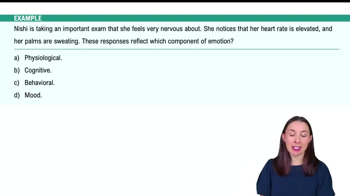
Emotion Example 1
625
views
4
rank
Terms in this set (15)
Hide definitions
Emotion
A brief, intense reaction to a stimulus involving bodily changes, thoughts, and outward behaviors, typically lasting minutes.
Mood
A diffuse, long-lasting state without a clear cause, lower in intensity than emotional reactions, and can last hours or days.
Valence
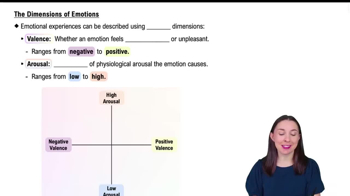
A dimension describing how pleasant or unpleasant an emotional experience feels, ranging from negative to positive.
Arousal
A dimension reflecting the level of physiological activation, from energizing high states to draining low states, during emotional experiences.
Physiological Changes
Bodily responses such as heart rate, respiration, or neurotransmitter activity that accompany emotional reactions.
Cognitive Processes
Mental activities including subjective feelings, labeling of emotions, and appraisals involved in emotional experiences.
Behavioral Expression
Outward signs of emotion, such as facial expressions or body language, that communicate internal states.
Appraisal
A cognitive evaluation or interpretation of a stimulus that influences the emotional response.
Subjective Feelings
Personal, internal experiences that help identify and label specific emotions.
Facial Expressions
Visible movements of facial muscles that convey emotional states to others.
Body Language
Nonverbal physical movements or postures that reflect emotional states.
Homeostasis
A state of physiological neutrality where the body shows no significant emotional activation or change.
Negative Valence
An emotional quality associated with unpleasant or aversive feelings.
Positive Valence
An emotional quality associated with pleasant or desirable feelings.
Emotional Intelligence
The capacity to recognize, understand, and manage one's own and others' emotional experiences.
 BackBack
 03:15
03:15