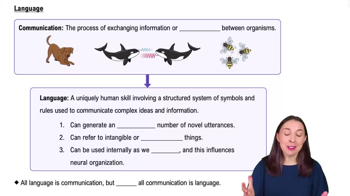
A uniquely human system of structured symbols and rules enabling expression of complex and abstract ideas, internal thought, and infinite novel utterances.
Communication
A broad process of exchanging information or signals, including vocal, body, or chemical forms, found across the animal kingdom.
Symbol
An element, such as a word, used to represent ideas or objects within a structured system for conveying meaning.
Grammar
A set of rules governing how words are combined to form meaningful sentences in a particular language.
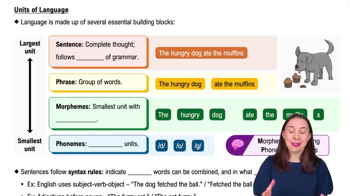
Sentence
A complete unit of language expressing a full thought, structured according to grammatical rules.
Phrase
A group of words that fit together but do not form a complete thought, often missing a subject, verb, or object.
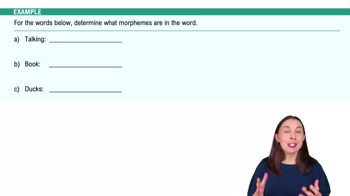
Morpheme
The smallest unit of language carrying meaning, including whole words, prefixes, suffixes, or plural markers.
Phoneme
The smallest distinct sound unit in a language, which can change meaning when altered.
Syntax
A system of rules specifying the order and combination of words within sentences, unique to each language.
Abstract Concept
An idea or notion not tied to physical objects or direct experiences, such as democracy or the future.
Internal Monologue
The use of language for self-reflection, mental categorization, and thought processes within the mind.
Plurality
A grammatical feature indicating more than one, often marked by a suffix like 's' in English.
Subject
The part of a sentence that typically indicates who or what is performing the action.
Object
The part of a sentence that typically receives the action performed by the subject.
Adjective
A word that modifies or describes a noun, often placed before the noun in English syntax.
 Back
Back
 04:00
04:00