Skip to main content
Psychology
My Course
Learn
Exam Prep
AI Tutor
Study Guides
Flashcards
Explore
Try the app
My Course
Learn
Exam Prep
AI Tutor
Study Guides
Flashcards
Explore
Try the app
Back
Theories of Emotion definitions
You can tap to flip the card.
Physiological Arousal
You can tap to flip the card.
👆
Physiological Arousal
Bodily changes like increased heart rate or respiration triggered by emotional stimuli, forming a core part of emotional experience.
Track progress
Control buttons has been changed to "navigation" mode.
1/15
Related flashcards
Related practice
Recommended videos
Theories of Emotion quiz #1
Theories of Emotion
40 Terms
Theories of Emotion quiz #2
Theories of Emotion
40 Terms
Theories of Emotion quiz #3
Theories of Emotion
40 Terms
Theories of Emotion
9. Emotion and Motivation
7 problems
Topic
Nicole
Appraisals and Action Tendencies
9. Emotion and Motivation
7 problems
Topic
Nicole
9. Emotion and Motivation
3 topics
9 problems
Chapter
Nicole
Guided course
02:28
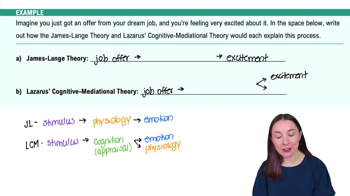
Theories of Emotion Example 1
601
views
4
rank
Guided course
01:34
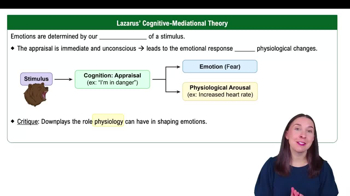
Lazarus' Cognitive-Mediational Theory
709
views
4
rank
Guided course
01:38
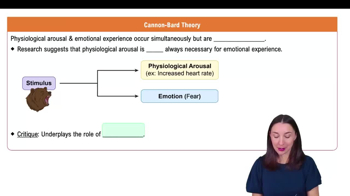
Cannon-Bard Theory
685
views
7
rank
Terms in this set (15)
Hide definitions
Physiological Arousal
Bodily changes like increased heart rate or respiration triggered by emotional stimuli, forming a core part of emotional experience.
Cognition
Mental processes involved in interpreting, appraising, and labeling emotional experiences based on context and thought.
Appraisal
Immediate, often unconscious evaluation of a stimulus that shapes both emotional and physiological responses.
James-Lange Theory
Model proposing that specific bodily changes precede and determine the emotional experience.
Cannon-Bard Theory
Model suggesting that physiological arousal and emotional experience occur at the same time but independently.
Schachter-Singer Two-Factor Theory
Model emphasizing general arousal and cognitive labeling as dual components in forming emotions.
Lazarus's Cognitive Mediational Theory
Model prioritizing appraisal as the trigger for both emotional and physiological responses.
Stimulus
External event or trigger that initiates the emotional process by activating physiological and cognitive components.
Emotional Experience
Subjective feeling resulting from the integration of physiological changes, cognition, and appraisal.
Autonomic Nervous System
Body system responsible for involuntary physiological responses, such as heart rate changes, during emotions.
Biofeedback
Information from the body, such as heart rate or muscle tension, that can influence emotional awareness.
Limitation
Shortcoming or critique of a theory, highlighting aspects it fails to explain about emotional processes.
General Arousal
Non-specific physiological activation that can be interpreted as different emotions depending on context.
Emotional Labeling
Process of identifying and naming a feeling based on physiological state and situational cues.
Physiological Profile
Unique pattern of bodily responses associated with a particular emotional state.
 BackBack
 02:28
02:28