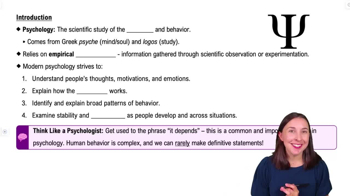
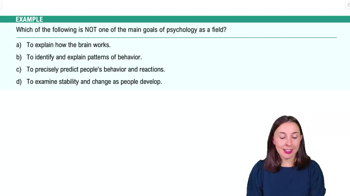
What is the primary focus of the Introduction to Psychology course?
The course introduces the science of human behavior and mental processes, emphasizing the nervous system, learning, perception, development, motivation, personality, psychopathology, and psychotherapy.
What are the course prerequisites for PSYC101?
There are no prerequisites or co-requisites for this course.
Name three major topics covered in the course content.
Nature-nurture interaction, fundamentals of social science research, and lifespan development.
What is the role of Canvas in this course?
Canvas is used for course information, announcements, assignments, and communication between students and the instructor.
How is attendance and participation graded?
Attendance and participation count for 20% of the grade, with points based on punctuality, full attendance, active participation, and documentation for absences.
What are the consequences of plagiarism or cheating in this course?
Plagiarized or cheated work receives a zero with no make-up or revision opportunities; multiple offenses may lead to disciplinary action.
What is the policy on make-up exams?
Make-ups for Exams #1-3 are allowed only with approved documentation and instructor approval; no make-ups for the Final Exam.
What are the key learning outcomes of the course?
Students will discuss psychology history, explain adaptation and natural selection, describe cognitive processes, explain motivation, discuss development, culture, personality, psychopathology, social psychology, and the scientific method.
What technology is required for this course?
Reliable internet, Google Chrome browser, Microsoft PowerPoint, Word, PDF viewer, and access to Canvas.
How are grades distributed across course components?
Attendance/Participation 20%, Assignments 20%, Exams #1-3 each 15%, Final Exam 15%.
What is the policy on late work submissions?
Late work is accepted only with approved third-party documentation and instructor approval; requests must be made within 48 hours of the due date.
What is the academic integrity expectation?
Students must submit original work, avoid unauthorized assistance, and properly cite sources to maintain honesty and fairness.
What topics are included under the fundamentals of learning?
Classical conditioning, operant conditioning, and observational/cognitive learning paradigms.
What is the attendance policy for late arrivals?
Arriving after attendance is taken counts as late; students must notify the instructor during break or after class to avoid being marked absent.
What accommodations are available for students with disabilities?
Student Accessibility Services provides reasonable accommodations based on documentation to ensure equity in education.
What is the policy on electronic device use in class?
Cell phones must be silenced and put away; laptops allowed only for academic purposes; misuse may lead to removal from class.
How does the course promote critical thinking?
By exploring psychological theories and research, students learn to evaluate psychological claims critically.
What is the grading scale for an A grade?
An A grade corresponds to a percentage range of 93 to 100.
What is the policy on recording class sessions?
Recording is prohibited unless authorized by Student Accessibility Services for accommodations.
What should students do if the instructor is absent?
Students must wait 15-20 minutes depending on class length, then sign attendance and notify the Faculty Secretary or email the instructor if remote.
 Back
Back
 01:11
01:11