 Back
BackPsychology Key Concepts Flashcards
 06:31
06:31
Terms in this set (33)
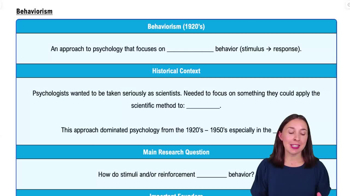
Focuses on observed behavior and the idea that behavior is learned.
Positive: Both variables increase or decrease together.
Negative: One variable increases while the other decreases.
No correlation: No relationship between variables.
Experimental group: Receives treatment.
Control group: Receives no treatment or placebo.
Independent variable (IV): The factor manipulated.
Dependent variable (DV): The factor measured.
Includes informed consent, participant rights, and debriefing with mental health resources.
Includes the brain and spinal cord, studied via lesioning, CT, MRI, EEG, PET, and fMRI.
Sympathetic: Fight, flight, or freeze responses.
Parasympathetic: Rest and digest functions.
Frontal: Personality, planning, impulse control.
Occipital: Visual processing.
Parietal: Touch, temperature.
Temporal: Hearing.
Includes figure-ground, proximity, similarity, closure, and continuity.
Includes linear perspective, texture gradient, aerial perspective, relative size, and interposition.
Physical: shaky hands, droopy eyelids.
Emotional: irritability, depression.
Cognitive: poor memory, concentration, problem solving.
Adaptive theory: Sleep protects from predators.
Restorative theory: Sleep repairs body and brain, supports memory.
Learning to make a reflex response to a previously neutral stimulus by pairing it with an unconditioned stimulus.
Learning controlled behavior through consequences: reinforcement increases behavior, punishment decreases behavior.
Positive reinforcement: Adding a desirable stimulus.
Negative reinforcement: Removing an aversive stimulus.
Fixed interval: Reinforcement after fixed time.
Variable interval: Reinforcement after varying time.
Fixed ratio: Reinforcement after fixed responses.
Variable ratio: Reinforcement after varying responses.
Encoding: Converting info to brain codes.
Storage: Holding info.
Retrieval: Accessing stored info.
Sensory memory: Brief storage.
Short-term memory: Holds info briefly.
Long-term memory: Permanent storage.
Declarative (explicit): Episodic and semantic memories.
Nondeclarative (implicit): Motor skills and conditioned reflexes.
1. Sensory-motor (0-2 yrs)
2. Preoperational (2-7 yrs)
3. Concrete operational (7-12 yrs)
4. Formal operational (12+ yrs)
1. Preconventional: consequences determine morality.
2. Conventional: conforming to social norms.
3. Postconventional: based on higher principles.
Secure, Avoidant, Ambivalent, and Disorganized, describing different patterns of caregiver bonding.
Eight stages from trust vs mistrust to integrity vs despair, each with a crisis and possible positive or negative outcome.
Sex: Biological characteristics.
Gender: Psychological and social aspects of being male, female, or other identities.
Heterosexual, homosexual, bisexual/pansexual, and asexual, based on sexual attraction.
Stressor: Event causing stress.
Stress: Reaction to the stressor, including physical, emotional, and cognitive responses.
Catastrophes, major life changes, and daily hassles; classified as internal/external, pleasant/unpleasant, chronic/acute.
Problem-focused: Eliminates stressor.
Emotion-focused: Changes emotional response.
Includes conformity, compliance, obedience, social roles, attitudes, stereotypes, prejudice, and prosocial behavior.
Discomfort when attitudes and behaviors conflict; resolved by changing behavior or cognition.
Id: Instinctual desires.
Ego: Reality-based mediator.
Superego: Moral conscience.
Oral, anal, phallic, latency, and genital stages, each with conflicts and erogenous zones.
Based on DSM-5-TR criteria including symptoms, duration, and cultural considerations.