6. Normal Distribution and Continuous Random Variables
Standard Normal Distribution

 3:00 minutes
Problem 7.2.29
Textbook Question
"In Problems 23–32, assume that the random variable X is normally distributed, with mean μ = 50 and standard deviation σ = 7. Compute the following probabilities. Be sure to draw a normal curve with the area corresponding to the probability shaded.
P(55 ≤ X < 70)"
 Verified step by step guidance
1
Identify the given parameters: the mean \( \mu = 50 \) and the standard deviation \( \sigma = 7 \). The random variable \( X \) follows a normal distribution \( N(50, 7) \).
Standardize the values 55 and 70 to convert them into \( z \)-scores using the formula:
\[ z = \frac{X - \mu}{\sigma} \]
Calculate \( z_1 = \frac{55 - 50}{7} \) and \( z_2 = \frac{70 - 50}{7} \).
Interpret the problem as finding the probability that \( X \) lies between 55 and 70, which translates to \( P(55 \leq X < 70) = P(z_1 \leq Z < z_2) \) where \( Z \) is the standard normal variable.
Use the standard normal distribution table or a calculator to find the cumulative probabilities corresponding to \( z_1 \) and \( z_2 \), denoted as \( \Phi(z_1) \) and \( \Phi(z_2) \) respectively.
Compute the desired probability by subtracting the cumulative probabilities:
\[ P(55 \leq X < 70) = \Phi(z_2) - \Phi(z_1) \]
This gives the area under the normal curve between 55 and 70.
Verified video answer for a similar problem:This video solution was recommended by our tutors as helpful for the problem above

Video duration:
3mKey Concepts
Here are the essential concepts you must grasp in order to answer the question correctly.
Normal Distribution
The normal distribution is a continuous probability distribution characterized by its symmetric, bell-shaped curve defined by the mean (μ) and standard deviation (σ). It models many natural phenomena and allows calculation of probabilities for ranges of values using the area under the curve.
Recommended video:
Guided course
 03:17
03:17
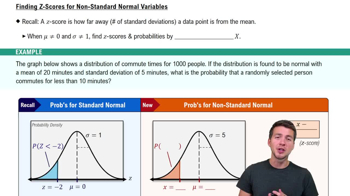
Finding Z-Scores for Non-Standard Normal Variables
Standardization (Z-Score)
Standardization converts a normal random variable X into a standard normal variable Z by subtracting the mean and dividing by the standard deviation: Z = (X - μ) / σ. This transformation allows use of standard normal tables to find probabilities for any normal distribution.
Recommended video:
Guided course
 06:31
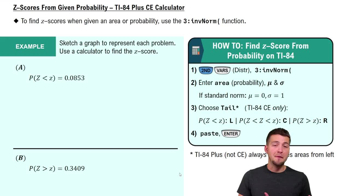
06:31Z-Scores From Given Probability - TI-84 (CE) Calculator
Probability as Area Under the Curve
In a normal distribution, the probability that X falls within a certain interval corresponds to the area under the curve between those values. Calculating P(55 ≤ X < 70) involves finding the area under the normal curve between 55 and 70, often using Z-scores and standard normal tables.
Recommended video:
 5:37
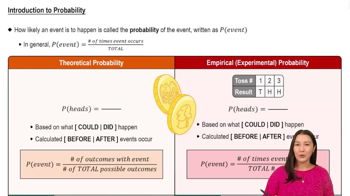
5:37Introduction to Probability
Related Videos
0