ESP A psychologist tells you that in an ESP (extrasensory perception) experiment, there is a 20% chance of answering a question correctly. What is the probability of answering a question correctly?
Verified step by step guidance
1
Step 1: Understand the problem. The psychologist states that there is a 20% chance of answering a question correctly. This means the probability of answering a question correctly is given as a percentage.
Step 2: Convert the percentage into a probability. Probabilities are expressed as values between 0 and 1. To convert a percentage to a probability, divide the percentage by 100. For example, 20% becomes 20/100.
Step 3: Write the probability in decimal form. After dividing, express the result as a decimal to represent the probability.
Step 4: Verify the probability value. Ensure that the probability is between 0 and 1, as probabilities cannot exceed this range.
Step 5: Conclude that the probability of answering a question correctly is the decimal value obtained in Step 3.
Verified video answer for a similar problem:
This video solution was recommended by our tutors as helpful for the problem above
Video duration:
1m
Play a video:
0 Comments
Key Concepts
Here are the essential concepts you must grasp in order to answer the question correctly.
Probability
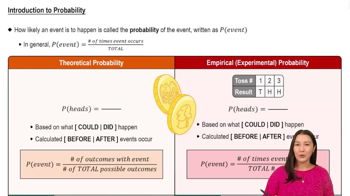
Probability is a measure of the likelihood that a particular event will occur, expressed as a number between 0 and 1. In this context, a probability of 0.20 indicates that there is a 20% chance of answering a question correctly, meaning that out of 100 attempts, one would expect to answer correctly about 20 times.
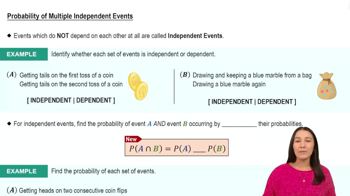
Independent events are those whose outcomes do not affect each other. In the context of the ESP experiment, if each question is answered independently, the probability of answering correctly remains constant at 20% for each question, regardless of previous answers.
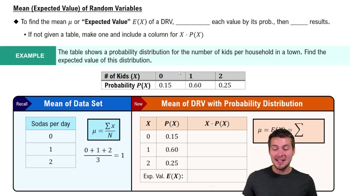
Expected value is a statistical concept that provides a measure of the center of a probability distribution. It is calculated by multiplying each possible outcome by its probability and summing these products. In this case, if you were to answer multiple questions, the expected number of correct answers can be calculated using the 20% probability.

 1:17 minutes
 Verified step by step guidance
 5:37
5:37