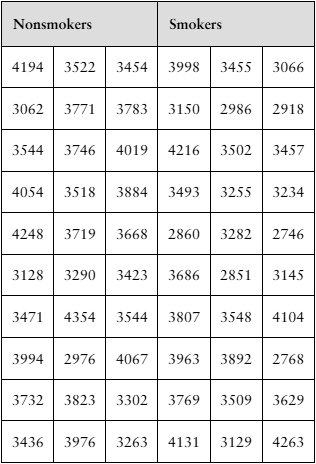
[DATA] Putting It Together: Paternal Smoking It is well-documented that active maternal smoking during pregnancy is associated with lower-birth-weight babies. Researchers wanted to determine if there is a relationship between paternal smoking habits and birth weight. The researchers administered a questionnaire to each parent of newborn infants. One question asked whether the individual smoked regularly. Because the survey was administered within 15 days of birth, it was assumed that any regular smokers were also regular smokers during pregnancy. Birth weights for the babies (in grams) of nonsmoking mothers were obtained and divided into two groups, nonsmoking fathers and smoking fathers. The given data are representative of the data collected by the researchers. The researchers concluded that the birth weight of babies whose father smoked was less than the birth weight of babies whose father did not smoke. b. What is the explanatory variable? What is the response variable?
Verified step by step guidance
1
Identify the explanatory variable, which is the variable that explains or influences changes in another variable. In this case, it is the smoking status of the father (nonsmoker or smoker).
Identify the response variable, which is the outcome or variable that is affected by the explanatory variable. Here, it is the birth weight of the babies measured in grams.
Understand that the data is grouped into two categories based on the explanatory variable: babies with nonsmoking fathers and babies with smoking fathers.
Recognize that the goal is to compare the birth weights (response variable) between these two groups to see if paternal smoking status has an effect.
Summarize: Explanatory variable = paternal smoking status (nonsmoker or smoker), Response variable = birth weight of babies (in grams).
Verified video answer for a similar problem:
This video solution was recommended by our tutors as helpful for the problem above
Video duration:
1m
Play a video:
0 Comments
Key Concepts
Here are the essential concepts you must grasp in order to answer the question correctly.
Explanatory Variable
The explanatory variable is the factor that is presumed to influence or explain changes in another variable. In this study, paternal smoking status (smoker or nonsmoker) is the explanatory variable because researchers want to see if it affects the birth weight of babies.
Intro to Random Variables & Probability Distributions
Response Variable
The response variable is the outcome or dependent variable that is measured to see if it changes due to the explanatory variable. Here, the birth weight of babies (measured in grams) is the response variable, as it is the characteristic being studied in relation to paternal smoking.
Intro to Random Variables & Probability Distributions
Comparative Data Analysis
Comparative data analysis involves comparing groups to identify differences or relationships. In this case, birth weights of babies with nonsmoking fathers are compared to those with smoking fathers to determine if paternal smoking is associated with lower birth weights.