In Exercises 9 and 10, find the expected net gain to the player for one play of the game.
It costs \$25 to bet on a horse race. The horse has a 1/8 chance of winning and a 1/4 chance of placing second or third. You win \$125 if the horse wins and receive your money back if the horse places second or third.
Verified step by step guidance
1
Step 1: Define the random variable X as the net gain for the player. The possible outcomes for X are: (1) winning the race, (2) placing second or third, and (3) losing the race.
Step 2: Calculate the net gain for each outcome. If the horse wins, the net gain is \$125 (winnings) - \$25 (cost of bet) = \$100. If the horse places second or third, the net gain is \$25 (money back) - \$25 (cost of bet) = \$0. If the horse loses, the net gain is -\$25 (cost of bet).
Step 3: Assign probabilities to each outcome. The probability of winning is 1/8, the probability of placing second or third is 1/4, and the probability of losing is 1 - (1/8 + 1/4) = 5/8.
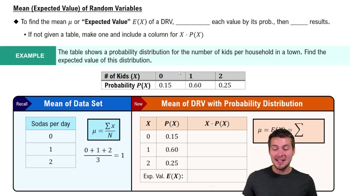
Step 4: Use the formula for expected value: E(X) = Σ [P(x) * x], where P(x) is the probability of each outcome and x is the corresponding net gain. Substitute the values: E(X) = (1/8 * 100) + (1/4 * 0) + (5/8 * -25).
Step 5: Simplify the expression to calculate the expected value. This will give the expected net gain for one play of the game.
Verified video answer for a similar problem:
This video solution was recommended by our tutors as helpful for the problem above
Video duration:
4m
Play a video:
0 Comments
Key Concepts
Here are the essential concepts you must grasp in order to answer the question correctly.
Expected Value
Expected value is a fundamental concept in probability and statistics that represents the average outcome of a random event when repeated many times. It is calculated by multiplying each possible outcome by its probability and summing these products. In the context of gambling, it helps determine the average net gain or loss per bet, guiding players in making informed decisions.
Probability quantifies the likelihood of an event occurring, expressed as a number between 0 and 1. In this scenario, the horse's chances of winning (1/8) and placing (1/4) are essential for calculating the expected net gain. Understanding these probabilities allows players to assess their potential returns based on the outcomes of the race.
Net gain refers to the total profit or loss from a bet after accounting for the initial investment. In this case, it involves calculating the winnings from the horse race and subtracting the cost of the bet. By determining the net gain for each possible outcome, players can evaluate the overall expected net gain from a single play of the game.