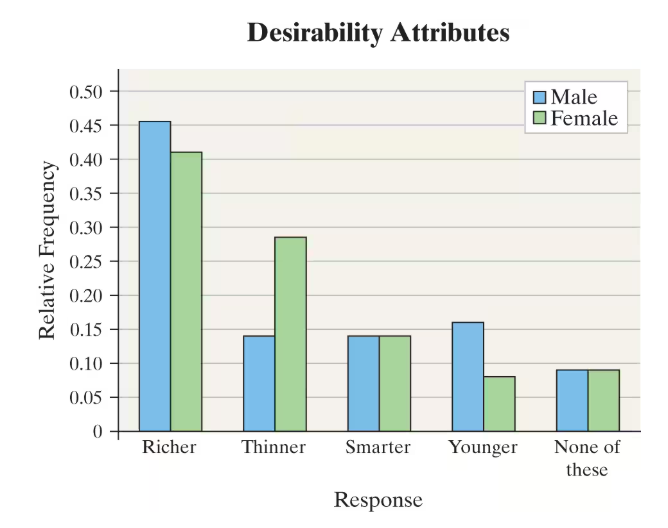
Desirability Attributes A random sample of 2163 adults (aged 18 and over) was asked, “Given a choice of the following, which one would you most want to be?” The results of the survey are presented in the side-by-side bar graph. Which attribute do females desire more than males?
Verified step by step guidance
1
Step 1: Understand the question. We need to determine which attribute females desire more than males based on the relative frequencies shown in the bar graph.
Step 2: Identify the attributes listed on the x-axis: Richer, Thinner, Smarter, Younger, and None of these.
Step 3: Compare the heights of the bars for males (blue) and females (green) for each attribute. The attribute where the green bar is taller than the blue bar indicates females desire that attribute more than males.
Step 4: Observe that for 'Thinner', the green bar (females) is noticeably taller than the blue bar (males), indicating a higher relative frequency for females.
Step 5: Conclude that the attribute females desire more than males is 'Thinner' based on the relative frequencies shown in the graph.
Verified video answer for a similar problem:
This video solution was recommended by our tutors as helpful for the problem above
Video duration:
2m
Play a video:
0 Comments
Key Concepts
Here are the essential concepts you must grasp in order to answer the question correctly.
Relative Frequency
Relative frequency represents the proportion of times a particular response occurs relative to the total number of responses. It is calculated by dividing the count of a specific category by the total sample size, providing a normalized measure to compare different groups or categories.
A side-by-side bar graph displays two or more groups' data for the same categories next to each other, facilitating direct comparison. In this case, it compares males and females across different desirability attributes, making it easier to identify which attribute is preferred more by each gender.
Comparative analysis involves examining differences in categorical data between groups. Here, it means comparing the relative frequencies of males and females for each attribute to determine which attribute females desire more than males, based on the height of the bars in the graph.