Rolling a Die What is the probability of obtaining 4 ones in a row when rolling a fair, six-sided die? Interpret this probability.
Verified step by step guidance
1
Identify the probability of rolling a one on a single roll of a fair six-sided die. Since the die has 6 faces and only one face shows a one, the probability is \(\frac{1}{6}\).
Recognize that rolling the die multiple times independently means the probabilities multiply for consecutive events. Here, we want 4 ones in a row, so we multiply the single-roll probability four times.
Write the expression for the probability of getting 4 ones in a row as \(\left(\frac{1}{6}\right)^4\).
Calculate or simplify the expression if needed (though the problem asks not to compute the final value, understanding the form is important).
Interpret the probability: it represents the chance that when rolling a fair six-sided die four times consecutively, all four outcomes will be the number one.
Verified video answer for a similar problem:
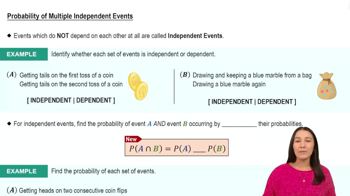
This video solution was recommended by our tutors as helpful for the problem above
Video duration:
2m
Play a video:
0 Comments
Key Concepts
Here are the essential concepts you must grasp in order to answer the question correctly.
Probability of a Single Event
This concept refers to the likelihood of a specific outcome occurring in a single trial. For a fair six-sided die, the probability of rolling a one is 1/6, since there is one favorable outcome out of six possible outcomes.
Independent events are those whose outcomes do not affect each other. When rolling a die multiple times, each roll is independent, meaning the result of one roll does not influence the next.
To find the probability of multiple independent events all occurring, multiply their individual probabilities. For example, the probability of rolling four ones in a row is (1/6) × (1/6) × (1/6) × (1/6) = (1/6)^4.