Employee Wellness A survey of employed U.S. adults found that only 35% believe their employer cares about their well-being. You randomly select a sample of U.S. employees. Find the probability that fewer than 100 believe their employer cares about their well-being. (Source: Gallup)
c. You select 400 U.S. employees.
Verified step by step guidance
1
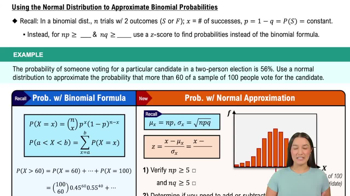
Step 1: Identify the type of probability distribution to use. Since the problem involves a proportion (35%) and a sample size (n = 400), this is a binomial distribution. However, because the sample size is large, we can approximate the binomial distribution using a normal distribution. Verify the conditions for normal approximation: np ≥ 10 and n(1-p) ≥ 10. Here, np = 400 × 0.35 = 140 and n(1-p) = 400 × 0.65 = 260, both of which satisfy the conditions.
Step 2: Calculate the mean (μ) and standard deviation (σ) of the normal distribution. The mean is given by μ = np, and the standard deviation is given by σ = √(np(1-p)). Substitute the values: μ = 140 and σ = √(140 × 0.65).
Step 3: Convert the problem into a z-score calculation. To find the probability that fewer than 100 employees believe their employer cares about their well-being, calculate the z-score using the formula z = (X - μ) / σ, where X = 100, μ = 140, and σ is the standard deviation calculated in Step 2.
Step 4: Use the z-score to find the cumulative probability. Look up the z-score in a standard normal distribution table or use statistical software to find the cumulative probability corresponding to the z-score calculated in Step 3.
Step 5: Interpret the result. The cumulative probability obtained in Step 4 represents the probability that fewer than 100 employees in the sample believe their employer cares about their well-being.
Verified video answer for a similar problem:

This video solution was recommended by our tutors as helpful for the problem above
Video duration:
8m
Play a video:
0 Comments
Key Concepts
Here are the essential concepts you must grasp in order to answer the question correctly.
Probability Distribution
A probability distribution describes how the probabilities of a random variable are distributed across its possible values. In this context, we can use the binomial distribution since we are dealing with a fixed number of trials (400 employees) and two possible outcomes (believing or not believing that the employer cares). Understanding this distribution is crucial for calculating the probability of fewer than 100 employees expressing concern for their well-being.
Calculating Probabilities in a Binomial Distribution
Binomial Probability Formula
The binomial probability formula calculates the likelihood of obtaining a specific number of successes in a fixed number of independent Bernoulli trials. It is expressed as P(X = k) = (n choose k) * p^k * (1-p)^(n-k), where n is the number of trials, k is the number of successes, and p is the probability of success. This formula will help determine the probability of fewer than 100 employees believing their employer cares.
Calculating Probabilities in a Binomial Distribution
Normal Approximation to the Binomial
For large sample sizes, the binomial distribution can be approximated by a normal distribution, which simplifies calculations. This approximation is valid when both np and n(1-p) are greater than 5. In this scenario, with 400 employees and a success probability of 0.35, we can use the normal distribution to find the probability of fewer than 100 employees believing their employer cares, making the calculations more manageable.