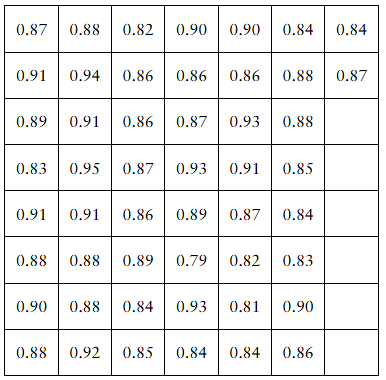
M&Ms The following data represent the weights (in grams) of a simple random sample of 50 M&M plain candies. Determine the shape of the distribution of weights of M&Ms by drawing a frequency histogram. Find the mean and median. Which measure of central tendency better describes the weight of a plain M&M?
Verified step by step guidance
1
Step 1: Organize the data by creating a frequency distribution table. Group the weights into intervals (bins), for example, intervals of 0.05 grams such as 0.75-0.79, 0.80-0.84, 0.85-0.89, 0.90-0.94, etc. Count how many M&M weights fall into each interval.
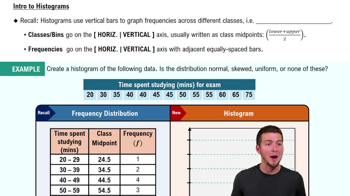
Step 2: Use the frequency distribution to draw a histogram. On the horizontal axis, place the weight intervals, and on the vertical axis, place the frequency (number of M&Ms in each interval). Draw bars for each interval with heights corresponding to their frequencies.
Step 3: Calculate the mean (average) weight of the M&Ms using the formula: \(\text{Mean} = \frac{\sum x_i}{n}\), where \(x_i\) are the individual weights and \(n\) is the total number of M&Ms (50 in this case).
Step 4: Find the median weight by first ordering all 50 weights from smallest to largest. Since there are an even number of observations, the median is the average of the 25th and 26th values in the ordered list.
Step 5: Compare the mean and median to determine which measure better describes the central tendency. Consider the shape of the histogram: if the distribution is symmetric, mean and median will be close; if skewed, the median is often a better measure because it is less affected by extreme values.
Verified video answer for a similar problem:
This video solution was recommended by our tutors as helpful for the problem above
Video duration:
2m
Play a video:
0 Comments
Key Concepts
Here are the essential concepts you must grasp in order to answer the question correctly.
Frequency Histogram
A frequency histogram is a graphical representation that organizes data into intervals or bins, showing the number of observations within each range. It helps visualize the shape, spread, and central tendency of the data distribution, making it easier to identify patterns such as skewness or modality.
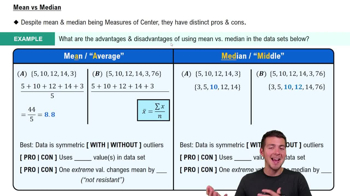
The mean is the arithmetic average of all data points, calculated by summing values and dividing by the count. The median is the middle value when data are ordered. Both measure central tendency, but the median is less affected by outliers or skewed data, providing a better central value in such cases.
Shape of Distribution and Choosing Central Tendency
The shape of a distribution (e.g., symmetric, skewed) influences which measure of central tendency best represents the data. For symmetric distributions, the mean and median are similar, but for skewed distributions, the median better reflects the typical value, as it is not distorted by extreme values.