Critical Thinking. In Exercises 17–28, use the data and confidence level to construct a confidence interval estimate of p, then address the given question.
Tennis Challenges In a recent U. S. Open tennis tournament, women playing singles matches used challenges on 137 calls made by the line judges. Among those challenges, 33 were found to be successful with the call overturned.
a. Construct a 99% confidence interval for the percentage of successful challenges.
Verified step by step guidance
1
Step 1: Identify the given data and parameters. The number of challenges is 137, and the number of successful challenges is 33. The confidence level is 99%, which corresponds to a significance level (α) of 0.01.
Step 2: Calculate the sample proportion (p̂) of successful challenges. The formula for the sample proportion is p̂ = x / n, where x is the number of successes (33) and n is the total number of trials (137).
Step 3: Determine the critical value (z*) for a 99% confidence level. Use a standard normal distribution table or calculator to find the z* value corresponding to a 99% confidence level. For a two-tailed test, z* is approximately 2.576.
Step 4: Calculate the standard error (SE) of the sample proportion. The formula for the standard error is SE = sqrt((p̂ * (1 - p̂)) / n), where p̂ is the sample proportion and n is the sample size.
Step 5: Construct the confidence interval for the population proportion (p). The formula for the confidence interval is p̂ ± z* × SE. Substitute the values of p̂, z*, and SE into the formula to compute the lower and upper bounds of the confidence interval.
Verified video answer for a similar problem:
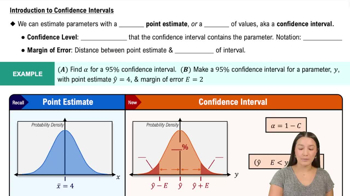
This video solution was recommended by our tutors as helpful for the problem above
Video duration:
3m
Play a video:
0 Comments
Key Concepts
Here are the essential concepts you must grasp in order to answer the question correctly.
Confidence Interval
A confidence interval is a range of values, derived from sample statistics, that is likely to contain the true population parameter with a specified level of confidence. For example, a 99% confidence interval suggests that if we were to take many samples and construct intervals in the same way, approximately 99% of those intervals would contain the true proportion of successful challenges.
In statistics, a proportion is a type of ratio that represents the part of a whole. In this context, it refers to the ratio of successful challenges to the total number of challenges made. The sample proportion can be calculated by dividing the number of successful challenges (33) by the total challenges (137), which is essential for constructing the confidence interval.
The margin of error quantifies the uncertainty associated with a sample estimate. It is calculated using the standard error of the sample proportion and a critical value from the Z-distribution corresponding to the desired confidence level. For a 99% confidence interval, the margin of error helps determine how far the sample proportion may deviate from the true population proportion, thus defining the width of the confidence interval.