
P-VALUE The test statistic of z = 2.14 is obtained when using the data from Exercise 1 and testing the claim that patients treated with dexamethasone and patients given a placebo have the same rate of complete resolution.
a. Find the P-value for the test.
Verified step by step guidance
1
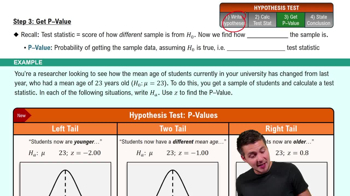
Step 1: Understand the context of the problem. The test statistic z = 2.14 is given, and we are testing the claim that there is no difference in the rate of complete resolution between two groups (dexamethasone and placebo). This is a two-tailed test because we are testing for equality (no difference).
Step 2: Recall the relationship between the z-score and the P-value. The P-value represents the probability of observing a test statistic as extreme as, or more extreme than, the observed value under the null hypothesis. For a two-tailed test, the P-value is calculated as: \( P = 2 \cdot P(Z > |z|) \), where \( Z \) follows the standard normal distribution.
Step 3: Use the standard normal distribution table (or a statistical software) to find the area to the right of \( |z| = 2.14 \). This area corresponds to \( P(Z > 2.14) \).
Step 4: Multiply the result from Step 3 by 2 to account for the two-tailed nature of the test. This gives the total P-value: \( P = 2 \cdot P(Z > 2.14) \).
Step 5: Compare the calculated P-value to the significance level (\( \alpha \)) to determine whether to reject or fail to reject the null hypothesis. If \( P < \alpha \), reject the null hypothesis; otherwise, fail to reject it.
Verified video answer for a similar problem:
This video solution was recommended by our tutors as helpful for the problem above
Video duration:
2m
Play a video:
0 Comments
Key Concepts
Here are the essential concepts you must grasp in order to answer the question correctly.
P-Value
The P-value is a statistical measure that helps determine the significance of results from a hypothesis test. It represents the probability of obtaining a test statistic at least as extreme as the one observed, assuming the null hypothesis is true. A smaller P-value indicates stronger evidence against the null hypothesis, often leading to its rejection.
Hypothesis testing is a statistical method used to make inferences about population parameters based on sample data. It involves formulating a null hypothesis (H0) and an alternative hypothesis (H1), then using sample data to determine whether to reject H0. The outcome is often guided by the P-value, which indicates the strength of evidence against H0.
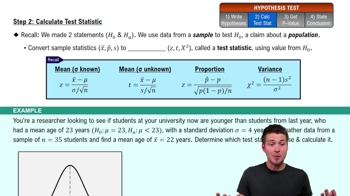
A test statistic is a standardized value that is calculated from sample data during a hypothesis test. It quantifies the difference between the observed data and what is expected under the null hypothesis. In this case, a z-test statistic of 2.14 indicates how many standard deviations the sample mean is from the population mean under H0, which is crucial for calculating the P-value.