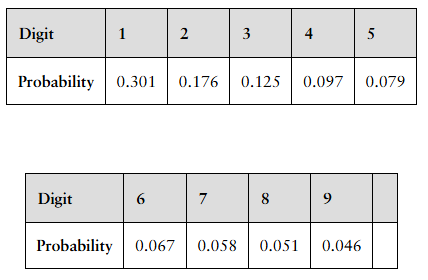
Benford’s Law, Part I Our number system consists of the digits 0, 1, 2, 3, 4, 5, 6, 7, 8, and 9. The first significant digit in any number must be 1, 2, 3, 4, 5, 6, 7, 8, or 9 because we do not write numbers such as 12 as 012. Although we may think that each first digit appears with equal frequency so that each digit has a 1/9 probability of being the first significant digit, this is not true. In 1881, Simon Newcomb discovered that first digits do not occur with equal frequency. This same result was discovered again in 1938 by physicist Frank Benford. After studying much data, he was able to assign probabilities of occurrence to the first digit in a number as shown. [Image] Source: T. P. Hill, “The First Digit Phenomenon,” American Scientist, July—August, 1998. The probability distribution is now known as Benford’s Law and plays a major role in identifying fraudulent data on tax returns and accounting books. For example, the following distribution represents the first digits in 200 allegedly fraudulent checks written to a bogus company by an employee attempting to embezzle funds from his employer. a. Because these data are meant to prove that someone is guilty of fraud, what would be an appropriate level of significance when performing a goodness-of-fit test?
Verified step by step guidance
1
Understand the context: The problem involves testing whether the observed first-digit distribution of 200 checks follows Benford's Law, which provides expected probabilities for each digit from 1 to 9.
Identify the null and alternative hypotheses for the goodness-of-fit test: The null hypothesis (H0) states that the observed data follow Benford's Law distribution, while the alternative hypothesis (H1) states that the data do not follow this distribution.
Choose an appropriate level of significance (α): Since the test is used to detect potential fraud, it is important to minimize the chance of falsely accusing someone (Type I error). Common significance levels are 0.05 or 0.01, but for fraud detection, a stricter level such as 0.01 might be more appropriate to reduce false positives.
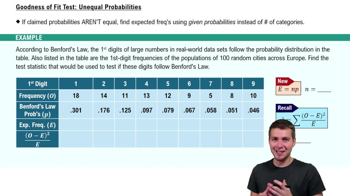
Calculate the expected frequencies for each digit by multiplying the total number of observations (200) by the corresponding Benford's Law probabilities: For each digit d, Expected frequency = 200 × P(d), where P(d) is the probability from the table.
Perform the chi-square goodness-of-fit test by comparing observed and expected frequencies, then decide whether to reject H0 based on the chosen significance level and the chi-square test statistic.
Verified video answer for a similar problem:
This video solution was recommended by our tutors as helpful for the problem above
Video duration:
1m
Play a video:
0 Comments
Key Concepts
Here are the essential concepts you must grasp in order to answer the question correctly.
Benford's Law
Benford's Law describes the frequency distribution of the first significant digit in many real-life sets of numerical data. Contrary to intuition, lower digits like 1 appear as the first digit more frequently than higher digits, with probabilities decreasing logarithmically from 1 to 9. This law is useful in detecting anomalies or fraud in datasets such as financial records.
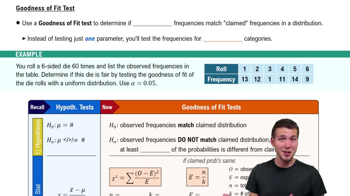
A goodness-of-fit test evaluates how well observed data match an expected distribution, such as Benford's Law. It compares observed frequencies with expected probabilities to determine if deviations are due to chance or indicate a significant difference. Common tests include the Chi-square test, which requires selecting a significance level to decide whether to reject the null hypothesis.
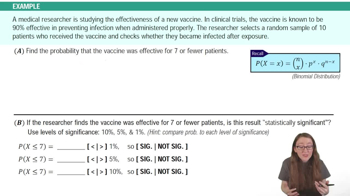
The level of significance (alpha) is the threshold probability for rejecting the null hypothesis in hypothesis testing. It represents the risk of a Type I error—incorrectly concluding fraud when none exists. In fraud detection, a common choice is 0.05 or lower to minimize false accusations, balancing sensitivity and reliability in the test results.