The procedure for constructing a confidence interval about a mean is ________, which means minor departures from normality do not affect the accuracy of the interval.
Table of contents
- 1. Intro to Stats and Collecting Data1h 14m
- 2. Describing Data with Tables and Graphs1h 56m
- 3. Describing Data Numerically2h 5m
- 4. Probability2h 17m
- 5. Binomial Distribution & Discrete Random Variables3h 6m
- 6. Normal Distribution and Continuous Random Variables2h 11m
- 7. Sampling Distributions & Confidence Intervals: Mean3h 23m
- Sampling Distribution of the Sample Mean and Central Limit Theorem19m
- Distribution of Sample Mean - ExcelBonus23m
- Introduction to Confidence Intervals15m
- Confidence Intervals for Population Mean1h 18m
- Determining the Minimum Sample Size Required12m
- Finding Probabilities and T Critical Values - ExcelBonus28m
- Confidence Intervals for Population Means - ExcelBonus25m
- 8. Sampling Distributions & Confidence Intervals: Proportion2h 10m
- 9. Hypothesis Testing for One Sample5h 8m
- Steps in Hypothesis Testing1h 6m
- Performing Hypothesis Tests: Means1h 4m
- Hypothesis Testing: Means - ExcelBonus42m
- Performing Hypothesis Tests: Proportions37m
- Hypothesis Testing: Proportions - ExcelBonus27m
- Performing Hypothesis Tests: Variance12m
- Critical Values and Rejection Regions28m
- Link Between Confidence Intervals and Hypothesis Testing12m
- Type I & Type II Errors16m
- 10. Hypothesis Testing for Two Samples5h 37m
- Two Proportions1h 13m
- Two Proportions Hypothesis Test - ExcelBonus28m
- Two Means - Unknown, Unequal Variance1h 3m
- Two Means - Unknown Variances Hypothesis Test - ExcelBonus12m
- Two Means - Unknown, Equal Variance15m
- Two Means - Unknown, Equal Variances Hypothesis Test - ExcelBonus9m
- Two Means - Known Variance12m
- Two Means - Sigma Known Hypothesis Test - ExcelBonus21m
- Two Means - Matched Pairs (Dependent Samples)42m
- Matched Pairs Hypothesis Test - ExcelBonus12m
- Two Variances and F Distribution29m
- Two Variances - Graphing CalculatorBonus16m
- 11. Correlation1h 24m
- 12. Regression3h 33m
- Linear Regression & Least Squares Method26m
- Residuals12m
- Coefficient of Determination12m
- Regression Line Equation and Coefficient of Determination - ExcelBonus8m
- Finding Residuals and Creating Residual Plots - ExcelBonus11m
- Inferences for Slope31m
- Enabling Data Analysis ToolpakBonus1m
- Regression Readout of the Data Analysis Toolpak - ExcelBonus21m
- Prediction Intervals13m
- Prediction Intervals - ExcelBonus19m
- Multiple Regression - ExcelBonus29m
- Quadratic Regression15m
- Quadratic Regression - ExcelBonus10m
- 13. Chi-Square Tests & Goodness of Fit2h 21m
- 14. ANOVA2h 29m
7. Sampling Distributions & Confidence Intervals: Mean
Introduction to Confidence Intervals
Problem 9.5.2
Textbook Question
If we wish to obtain a 95% confidence interval of a parameter using the bootstrap percentile method, we determine the_______percentile and the_______ percentile of the resampled distribution.
Verified step by step guidance1
Understand that the bootstrap percentile method constructs a confidence interval by using percentiles from the bootstrap resampled distribution of the estimator.
For a 95% confidence interval, the total area in the tails outside the interval is 5%, which is split equally between the lower and upper tails.
Calculate the lower percentile as the 2.5th percentile, which corresponds to half of the 5% in the lower tail (i.e., 5% / 2 = 2.5%).
Calculate the upper percentile as the 97.5th percentile, which corresponds to 100% minus the 2.5% in the upper tail (i.e., 100% - 2.5% = 97.5%).
The 95% bootstrap confidence interval is then given by the values at the 2.5th percentile and the 97.5th percentile of the bootstrap distribution.
Verified video answer for a similar problem:This video solution was recommended by our tutors as helpful for the problem above
Video duration:
2mPlay a video:
0 Comments
Key Concepts
Here are the essential concepts you must grasp in order to answer the question correctly.
Bootstrap Percentile Method
The bootstrap percentile method is a resampling technique used to estimate confidence intervals by repeatedly sampling with replacement from the data. It uses the percentiles of the bootstrap distribution of the estimator to form the interval, avoiding assumptions about the underlying population distribution.
Recommended video:
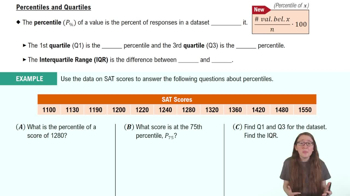
Percentiles and Quartiles
Confidence Interval
A confidence interval provides a range of values within which the true population parameter is expected to lie with a specified probability, such as 95%. It quantifies the uncertainty of an estimate based on sample data and helps in making statistical inferences.
Recommended video:
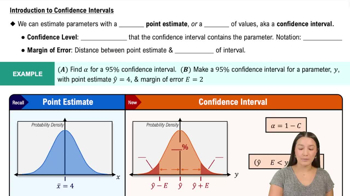
Introduction to Confidence Intervals
Percentiles in Bootstrap Distribution
Percentiles in the bootstrap distribution correspond to values below which a certain percentage of bootstrap estimates fall. For a 95% confidence interval using the percentile method, the lower and upper bounds are the 2.5th and 97.5th percentiles of the bootstrap estimates, capturing the central 95% of the distribution.
Recommended video:
Percentiles and Quartiles
Related Videos
Related Practice
Textbook Question
40
views