
 2:46 minutes

 03:17
03:17
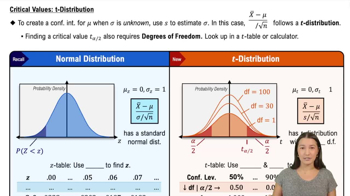
"A second method for finding a bootstrap confidence interval is called the Bootstrap t-Method. This method requires estimating the standard error of the estimate (such as the standard error of the mean) from the bootstrap sample. For any given set of estimates of a parameter, the standard error of the estimate is found by determining the sample standard deviation of the B bootstrap estimates. For example, in Example 1, we found 2000 estimates of the sample mean mpg. The standard deviation of these 2000 sample means is found to be 0.580. The standard deviation of the 16 observations is 2.38, so
s / sqrt(n) = 2.38 / sqrt(16) = 0.595,
is close to the standard error of the estimate found from the bootstrap samples. The estimate of the standard error from Figure 28 in Example 2 is 0.560. We can use an estimate of the standard error (SE_est) along with critical values from Student's t-distribution (Table VII) to construct confidence intervals as follows:
statistic ± t_(alpha/2) * SE_est
For example, in Example 1 we know x̄ = 28.1 and n = 16, so for a 95% confidence interval, t_0.025 = 2.131 using 15 degrees of freedom. Using the standard error estimate from Example 1, we find the lower bound of the confidence interval to be 28.1 – 2.131(0.580) = 26.86 mpg and the upper bound to be 28.1 + 2.131(0.580) = 29.34.
pH of Rain Revisited See Problem 7. Use the Bootstrap t-Method to find a 95% confidence for the mean pH of rainwater in Tucker County, West Virginia."