The mean annual salary for a sample of electrical engineers is \$86,500, with a standard deviation of \$1500. The data set has a bell-shaped distribution.
b. The salaries of three randomly selected electrical engineers are \$93,500, \$85,600, and \$82,750. Find the z-score that corresponds to each salary. Determine whether any of these salaries are unusual.
Verified step by step guidance
1
Step 1: Recall the formula for calculating the z-score: , where is the data point, is the mean, and is the standard deviation.
Step 2: Substitute the given values into the formula for each salary. For the first salary, \$93,500, calculate . For the second salary, \$85,600, calculate . For the third salary, \$82,750, calculate .
Step 3: Simplify the numerator for each calculation. For the first salary, compute . For the second salary, compute . For the third salary, compute .
Step 4: Divide the result of each numerator by the standard deviation, , to find the z-scores for each salary.
Step 5: Determine whether any of the z-scores are unusual. Recall that a z-score is considered unusual if it is less than -2 or greater than 2. Compare each calculated z-score to this threshold to identify any unusual salaries.
Verified video answer for a similar problem:
This video solution was recommended by our tutors as helpful for the problem above
Video duration:
1m
Play a video:
0 Comments
Key Concepts
Here are the essential concepts you must grasp in order to answer the question correctly.
Z-Score
A Z-score measures how many standard deviations a data point is from the mean of a dataset. It is calculated using the formula Z = (X - μ) / σ, where X is the value, μ is the mean, and σ is the standard deviation. A Z-score helps in identifying how unusual or typical a value is within a distribution, particularly in a normal distribution.
Z-Scores From Given Probability - TI-84 (CE) Calculator
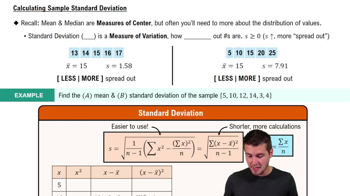
Standard Deviation
Standard deviation quantifies the amount of variation or dispersion in a set of values. A low standard deviation indicates that the values tend to be close to the mean, while a high standard deviation indicates that the values are spread out over a wider range. In this context, the standard deviation of $1500 provides insight into the variability of electrical engineers' salaries around the mean of $86,500.
A normal distribution is a probability distribution that is symmetric about the mean, showing that data near the mean are more frequent in occurrence than data far from the mean. It is characterized by its bell-shaped curve. In this scenario, the mention of a bell-shaped distribution implies that the salaries of electrical engineers follow this pattern, allowing for the application of Z-scores to assess the unusualness of specific salaries.