Find the positive z-score for which 94% of the distribution’s area lies between -z and z.
Verified step by step guidance
1
Understand the problem: We are tasked with finding the positive z-score such that 94% of the distribution's area lies between -z and z. This means the total area in the tails (outside of -z and z) is 1 - 0.94 = 0.06, and each tail contains 0.03 (since the normal distribution is symmetric).
Determine the cumulative area to the left of the positive z-score: Since the area in the left tail is 0.03, the cumulative area to the left of the positive z-score is 0.03 + 0.94 = 0.97.
Use the standard normal distribution table (or a statistical software) to find the z-score corresponding to a cumulative probability of 0.97. This z-score represents the value where 97% of the distribution lies to the left.
Verify the symmetry of the normal distribution: The z-score found will be positive, and its negative counterpart (-z) will have the same cumulative area of 0.03 to the left, ensuring that the total area between -z and z is 94%.
Conclude the solution: The positive z-score obtained from the table or software is the required value. Ensure that the z-score is rounded appropriately based on the context or instructions provided.
Verified video answer for a similar problem:
This video solution was recommended by our tutors as helpful for the problem above
Video duration:
2m
Play a video:
0 Comments
Key Concepts
Here are the essential concepts you must grasp in order to answer the question correctly.
Z-Score
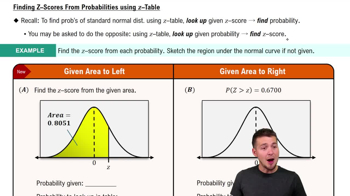
A z-score is a statistical measurement that describes a value's relationship to the mean of a group of values. It indicates how many standard deviations an element is from the mean. In the context of a normal distribution, a positive z-score signifies that the value is above the mean, while a negative z-score indicates it is below the mean.
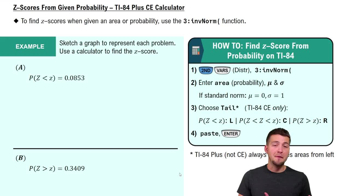
Z-Scores From Given Probability - TI-84 (CE) Calculator
Normal Distribution
The normal distribution is a continuous probability distribution characterized by its bell-shaped curve, symmetric about the mean. It is defined by two parameters: the mean (average) and the standard deviation (spread). In a normal distribution, approximately 68% of the data falls within one standard deviation of the mean, 95% within two, and 99.7% within three, which is known as the empirical rule.
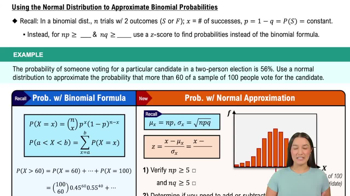
Using the Normal Distribution to Approximate Binomial Probabilities
Area Under the Curve
In statistics, the area under the curve (AUC) of a probability distribution represents the probability of a random variable falling within a certain range. For a standard normal distribution, the total area under the curve is 1. When finding z-scores, the area between -z and z corresponds to the probability that a value lies within that range, which can be used to determine the z-score for a given percentile.