
Table of contents
- 1. Intro to Stats and Collecting Data1h 14m
- 2. Describing Data with Tables and Graphs1h 55m
- 3. Describing Data Numerically2h 5m
- 4. Probability2h 16m
- 5. Binomial Distribution & Discrete Random Variables3h 6m
- 6. Normal Distribution and Continuous Random Variables2h 11m
- 7. Sampling Distributions & Confidence Intervals: Mean3h 23m
- Sampling Distribution of the Sample Mean and Central Limit Theorem19m
- Distribution of Sample Mean - Excel23m
- Introduction to Confidence Intervals15m
- Confidence Intervals for Population Mean1h 18m
- Determining the Minimum Sample Size Required12m
- Finding Probabilities and T Critical Values - Excel28m
- Confidence Intervals for Population Means - Excel25m
- 8. Sampling Distributions & Confidence Intervals: Proportion2h 10m
- 9. Hypothesis Testing for One Sample5h 8m
- Steps in Hypothesis Testing1h 6m
- Performing Hypothesis Tests: Means1h 4m
- Hypothesis Testing: Means - Excel42m
- Performing Hypothesis Tests: Proportions37m
- Hypothesis Testing: Proportions - Excel27m
- Performing Hypothesis Tests: Variance12m
- Critical Values and Rejection Regions28m
- Link Between Confidence Intervals and Hypothesis Testing12m
- Type I & Type II Errors16m
- 10. Hypothesis Testing for Two Samples5h 37m
- Two Proportions1h 13m
- Two Proportions Hypothesis Test - Excel28m
- Two Means - Unknown, Unequal Variance1h 3m
- Two Means - Unknown Variances Hypothesis Test - Excel12m
- Two Means - Unknown, Equal Variance15m
- Two Means - Unknown, Equal Variances Hypothesis Test - Excel9m
- Two Means - Known Variance12m
- Two Means - Sigma Known Hypothesis Test - Excel21m
- Two Means - Matched Pairs (Dependent Samples)42m
- Matched Pairs Hypothesis Test - Excel12m
- Two Variances and F Distribution29m
- Two Variances - Graphing Calculator16m
- 11. Correlation1h 24m
- 12. Regression3h 33m
- Linear Regression & Least Squares Method26m
- Residuals12m
- Coefficient of Determination12m
- Regression Line Equation and Coefficient of Determination - Excel8m
- Finding Residuals and Creating Residual Plots - Excel11m
- Inferences for Slope31m
- Enabling Data Analysis Toolpak1m
- Regression Readout of the Data Analysis Toolpak - Excel21m
- Prediction Intervals13m
- Prediction Intervals - Excel19m
- Multiple Regression - Excel29m
- Quadratic Regression15m
- Quadratic Regression - Excel10m
- 13. Chi-Square Tests & Goodness of Fit2h 21m
- 14. ANOVA2h 28m
5. Binomial Distribution & Discrete Random Variables
Discrete Random Variables
Problem 5.1.5
Textbook Question
Identifying Discrete and Continuous Random Variables. In Exercises 5 and 6, refer to the given values, then identify which of the following is most appropriate: discrete random variable, continuous random variable, or not a random variable.
a. IQ scores of statistics students
b. Exact heights of statistics students
c. Shoe sizes (such as 8 or 8½) of statistics students
d. Majors (such as history) of statistics students
e. The number of rolls of a die required for a statistics student to get the number 4
Verified step by step guidance1
Step 1: Understand the definitions of discrete and continuous random variables. A discrete random variable takes on a countable number of distinct values, such as integers or specific categories. A continuous random variable can take on any value within a given range, often involving measurements like height or weight. If the variable does not involve randomness, it is not a random variable.
Step 2: Analyze part (a): IQ scores of statistics students. IQ scores are numerical values but are typically measured in whole numbers and are not continuous measurements. Determine whether this fits the definition of a discrete random variable or not.
Step 3: Analyze part (b): Exact heights of statistics students. Heights are measured on a continuous scale, meaning they can take on any value within a range (e.g., 5.5 feet, 5.55 feet). Determine whether this fits the definition of a continuous random variable.
Step 4: Analyze part (c): Shoe sizes of statistics students. Shoe sizes are typically discrete values (e.g., 8, 8½) and are countable. Determine whether this fits the definition of a discrete random variable.
Step 5: Analyze parts (d) and (e): Majors of statistics students and the number of rolls of a die required to get a 4. Majors are categorical and not numerical, so they are not random variables. The number of rolls of a die is countable and fits the definition of a discrete random variable.
Verified video answer for a similar problem:This video solution was recommended by our tutors as helpful for the problem above
Video duration:
4mPlay a video:
Key Concepts
Here are the essential concepts you must grasp in order to answer the question correctly.
Discrete Random Variables
Discrete random variables are those that can take on a countable number of distinct values. Examples include the number of students in a class or the number of rolls of a die. These variables often represent counts or categories, making them suitable for statistical analysis where specific outcomes can be enumerated.
Recommended video:
Guided course
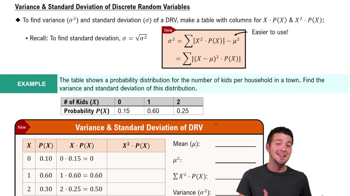
Variance & Standard Deviation of Discrete Random Variables
Continuous Random Variables
Continuous random variables can take on an infinite number of values within a given range. They are typically measurements, such as height or weight, where any value within a range is possible. This type of variable is often represented using intervals and is analyzed using techniques that account for the continuum of possible values.
Recommended video:
Guided course
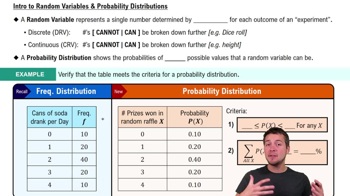
Intro to Random Variables & Probability Distributions
Random Variables
A random variable is a numerical outcome of a random phenomenon, which can be classified as either discrete or continuous. It serves as a bridge between probability and statistics, allowing for the quantification of uncertainty. Understanding random variables is essential for analyzing data and making predictions based on probabilistic models.
Recommended video:
Guided course
Intro to Random Variables & Probability Distributions
Watch next
Master Intro to Random Variables & Probability Distributions with a bite sized video explanation from Patrick
Start learningRelated Videos
Related Practice
Multiple Choice
Which of the following tables represents a valid probability distribution for a discrete random variable ?
3
views
