Suppose two independent random samples are taken from two normal populations with unknown and unequal variances. Which statistical test is most appropriate for testing whether the population means are equal?
Table of contents
- 1. Intro to Stats and Collecting Data1h 14m
- 2. Describing Data with Tables and Graphs1h 56m
- 3. Describing Data Numerically2h 5m
- 4. Probability2h 17m
- 5. Binomial Distribution & Discrete Random Variables3h 6m
- 6. Normal Distribution and Continuous Random Variables2h 11m
- 7. Sampling Distributions & Confidence Intervals: Mean3h 23m
- Sampling Distribution of the Sample Mean and Central Limit Theorem19m
- Distribution of Sample Mean - ExcelBonus23m
- Introduction to Confidence Intervals15m
- Confidence Intervals for Population Mean1h 18m
- Determining the Minimum Sample Size Required12m
- Finding Probabilities and T Critical Values - ExcelBonus28m
- Confidence Intervals for Population Means - ExcelBonus25m
- 8. Sampling Distributions & Confidence Intervals: Proportion2h 10m
- 9. Hypothesis Testing for One Sample5h 8m
- Steps in Hypothesis Testing1h 6m
- Performing Hypothesis Tests: Means1h 4m
- Hypothesis Testing: Means - ExcelBonus42m
- Performing Hypothesis Tests: Proportions37m
- Hypothesis Testing: Proportions - ExcelBonus27m
- Performing Hypothesis Tests: Variance12m
- Critical Values and Rejection Regions28m
- Link Between Confidence Intervals and Hypothesis Testing12m
- Type I & Type II Errors16m
- 10. Hypothesis Testing for Two Samples5h 37m
- Two Proportions1h 13m
- Two Proportions Hypothesis Test - ExcelBonus28m
- Two Means - Unknown, Unequal Variance1h 3m
- Two Means - Unknown Variances Hypothesis Test - ExcelBonus12m
- Two Means - Unknown, Equal Variance15m
- Two Means - Unknown, Equal Variances Hypothesis Test - ExcelBonus9m
- Two Means - Known Variance12m
- Two Means - Sigma Known Hypothesis Test - ExcelBonus21m
- Two Means - Matched Pairs (Dependent Samples)42m
- Matched Pairs Hypothesis Test - ExcelBonus12m
- Two Variances and F Distribution29m
- Two Variances - Graphing CalculatorBonus16m
- 11. Correlation1h 24m
- 12. Regression3h 33m
- Linear Regression & Least Squares Method26m
- Residuals12m
- Coefficient of Determination12m
- Regression Line Equation and Coefficient of Determination - ExcelBonus8m
- Finding Residuals and Creating Residual Plots - ExcelBonus11m
- Inferences for Slope31m
- Enabling Data Analysis ToolpakBonus1m
- Regression Readout of the Data Analysis Toolpak - ExcelBonus21m
- Prediction Intervals13m
- Prediction Intervals - ExcelBonus19m
- Multiple Regression - ExcelBonus29m
- Quadratic Regression15m
- Quadratic Regression - ExcelBonus10m
- 13. Chi-Square Tests & Goodness of Fit2h 21m
- 14. ANOVA2h 29m
10. Hypothesis Testing for Two Samples
Two Means - Unknown, Unequal Variance
Problem 9.2.5a
Textbook Question
In Exercises 5–20, assume that the two samples are independent simple random samples selected from normally distributed populations, and do not assume that the population standard deviations are equal. (Note: Answers in Appendix D include technology answers based on Formula 9-1 along with “Table” answers based on Table A-3 with df equal to the smaller of n1-1 and n2-1)
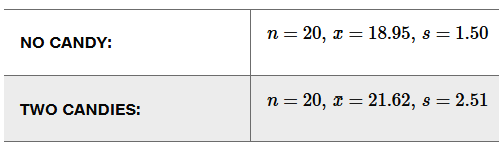
Better Tips by Giving Candy An experiment was conducted to determine whether giving candy to dining parties resulted in greater tips. The mean tip percentages and standard deviations are given below along with the sample sizes (based on data from “Sweetening the Till: The Use of Candy to Increase Restaurant Tipping,” by Strohmetz et al., Journal of Applied Social Psychology, Vol. 32, No. 2).
a. Use a 0.05 significance level to test the claim that giving candy does result in greater tips.

[Image]
Verified step by step guidance1
Step 1: Identify the null hypothesis (H₀) and the alternative hypothesis (H₁). The null hypothesis is H₀: μ₁ = μ₂ (mean tip percentages are the same for no candy and two candies). The alternative hypothesis is H₁: μ₁ < μ₂ (mean tip percentage is greater for two candies).
Step 2: Determine the test statistic formula for comparing two independent sample means when population standard deviations are not assumed to be equal. Use the formula: t = (x₁ - x₂) / sqrt((s₁²/n₁) + (s₂²/n₂)), where x₁ and x₂ are sample means, s₁ and s₂ are sample standard deviations, and n₁ and n₂ are sample sizes.
Step 3: Calculate the degrees of freedom (df) using the formula: df = [(s₁²/n₁ + s₂²/n₂)²] / {[(s₁²/n₁)² / (n₁ - 1)] + [(s₂²/n₂)² / (n₂ - 1)]}. This will help determine the critical t-value from the t-distribution table.
Step 4: Use the significance level (α = 0.05) and the calculated degrees of freedom to find the critical t-value from the t-distribution table. Compare the calculated t-statistic to the critical t-value to determine whether to reject or fail to reject the null hypothesis.
Step 5: Interpret the results. If the calculated t-statistic exceeds the critical t-value, reject the null hypothesis and conclude that giving candy results in greater tips. Otherwise, fail to reject the null hypothesis and conclude that there is insufficient evidence to support the claim.
Verified video answer for a similar problem:This video solution was recommended by our tutors as helpful for the problem above
Video duration:
5mPlay a video:
0 Comments
Key Concepts
Here are the essential concepts you must grasp in order to answer the question correctly.
Independent Samples
Independent samples refer to two or more groups that are not related or paired in any way. In this context, the dining parties receiving candy and those not receiving candy are treated as separate groups, allowing for the comparison of their mean tip percentages without any influence from one another.
Recommended video:
Sampling Distribution of Sample Proportion
Hypothesis Testing
Hypothesis testing is a statistical method used to determine if there is enough evidence to reject a null hypothesis in favor of an alternative hypothesis. In this scenario, the null hypothesis would state that giving candy does not affect tip percentages, while the alternative hypothesis posits that it does, guiding the analysis of the collected data.
Recommended video:
Guided course
Step 1: Write Hypotheses
Significance Level
The significance level, often denoted as alpha (α), is the threshold for determining whether the results of a hypothesis test are statistically significant. In this case, a significance level of 0.05 indicates that there is a 5% risk of concluding that a difference exists when there is none, which is the criterion used to evaluate the results of the tipping experiment.
Recommended video:
Guided course
Step 4: State Conclusion Example 4
Related Videos
Related Practice
Multiple Choice
67
views
