In Exercises 63–68, write the binomial probability in words. Then, use a continuity correction to convert the binomial probability to a normal distribution probability.
P(x < 60)
Verified step by step guidance
1
Step 1: Understand the problem. The binomial probability P(x < 60) represents the probability of observing fewer than 60 successes in a binomial experiment. The goal is to express this probability in words and then apply a continuity correction to approximate it using a normal distribution.
Step 2: Write the binomial probability in words. The probability P(x < 60) can be described as 'the probability that the number of successes is less than 60 in a binomial distribution.'
Step 3: Recall the concept of continuity correction. When approximating a binomial distribution using a normal distribution, a continuity correction is applied to account for the discrete nature of the binomial distribution. For P(x < 60), the continuity correction adjusts the inequality to P(x ≤ 59.5) in the normal distribution.
Step 4: Convert the binomial probability to a normal distribution probability. To do this, you need the mean (μ) and standard deviation (σ) of the binomial distribution. The mean is calculated as μ = n * p, and the standard deviation is calculated as σ = √(n * p * (1 - p)), where n is the number of trials and p is the probability of success.
Step 5: Standardize the normal distribution probability. Use the z-score formula z = (x - μ) / σ to convert the value x = 59.5 into a z-score. Then, use the standard normal distribution table or software to find the probability corresponding to this z-score.
Verified video answer for a similar problem:

This video solution was recommended by our tutors as helpful for the problem above
Video duration:
1m
Play a video:
0 Comments
Key Concepts
Here are the essential concepts you must grasp in order to answer the question correctly.
Binomial Probability
Binomial probability refers to the likelihood of obtaining a fixed number of successes in a fixed number of independent Bernoulli trials, each with the same probability of success. It is calculated using the binomial formula, which incorporates the number of trials, the number of successes, and the probability of success on each trial. This concept is essential for understanding scenarios where outcomes are binary, such as success/failure or yes/no.
Calculating Probabilities in a Binomial Distribution
Normal Distribution
The normal distribution is a continuous probability distribution characterized by its bell-shaped curve, defined by its mean and standard deviation. It is significant in statistics because many phenomena tend to follow this distribution due to the Central Limit Theorem, which states that the sum of a large number of independent random variables will approximate a normal distribution, regardless of the original distribution of the variables.
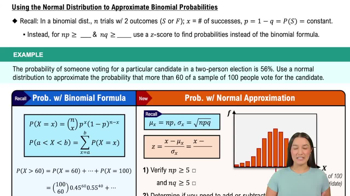
Using the Normal Distribution to Approximate Binomial Probabilities
Continuity Correction
Continuity correction is a technique used when approximating a discrete probability distribution, like the binomial distribution, with a continuous distribution, such as the normal distribution. This correction involves adjusting the discrete value by 0.5 to account for the fact that the normal distribution is continuous. For example, to find P(X < 60) in a binomial context, one would calculate P(X < 60.5) in the normal approximation.