
Textbook Question
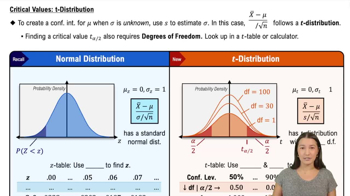
Explain how to find critical values for a t-distribution.
463
views

 Verified step by step guidance
 07:01
07:01
 05:50
05:50 09:56
09:56Explain how to find critical values for a t-distribution.
Identifying a Test In Exercises 21–24, determine whether the hypothesis test is left-tailed, right-tailed, or two-tailed.
Ha: μ ≥ 5.2
H0: μ < 5.2
Graphical Analysis In Exercises 17–20, match the alternative hypothesis with its graph. Then state the null hypothesis and sketch its graph.
Ha: μ ≠ 3
a.
b.
c.
d.
Stating the Null and Alternative Hypotheses In Exercises 25–30, write the claim as a mathematical statement. State the null and alternative hypotheses, and identify which represents the claim.
Tablets A tablet manufacturer claims that the mean life of the battery for a certain model of tablet is more than 8 hours.
In Exercises 3–8, find the critical value(s) and rejection region(s) for the type of t-test with level of significance alpha and sample size n.
Left-tailed test, α=0.01, n=35
Identifying Type I and Type II Errors In Exercises 31–36, describe type I and type II errors for a hypothesis test of the indicated claim.
Repeat Customers A used textbook selling website claims that at least 60% of its new customers will return to buy their next textbook.