The procedure for constructing a t-interval is robust. Explain what this means.
Table of contents
- 1. Intro to Stats and Collecting Data1h 14m
- 2. Describing Data with Tables and Graphs1h 56m
- 3. Describing Data Numerically2h 5m
- 4. Probability2h 17m
- 5. Binomial Distribution & Discrete Random Variables3h 6m
- 6. Normal Distribution and Continuous Random Variables2h 11m
- 7. Sampling Distributions & Confidence Intervals: Mean3h 23m
- Sampling Distribution of the Sample Mean and Central Limit Theorem19m
- Distribution of Sample Mean - ExcelBonus23m
- Introduction to Confidence Intervals15m
- Confidence Intervals for Population Mean1h 18m
- Determining the Minimum Sample Size Required12m
- Finding Probabilities and T Critical Values - ExcelBonus28m
- Confidence Intervals for Population Means - ExcelBonus25m
- 8. Sampling Distributions & Confidence Intervals: Proportion2h 10m
- 9. Hypothesis Testing for One Sample5h 8m
- Steps in Hypothesis Testing1h 6m
- Performing Hypothesis Tests: Means1h 4m
- Hypothesis Testing: Means - ExcelBonus42m
- Performing Hypothesis Tests: Proportions37m
- Hypothesis Testing: Proportions - ExcelBonus27m
- Performing Hypothesis Tests: Variance12m
- Critical Values and Rejection Regions28m
- Link Between Confidence Intervals and Hypothesis Testing12m
- Type I & Type II Errors16m
- 10. Hypothesis Testing for Two Samples5h 37m
- Two Proportions1h 13m
- Two Proportions Hypothesis Test - ExcelBonus28m
- Two Means - Unknown, Unequal Variance1h 3m
- Two Means - Unknown Variances Hypothesis Test - ExcelBonus12m
- Two Means - Unknown, Equal Variance15m
- Two Means - Unknown, Equal Variances Hypothesis Test - ExcelBonus9m
- Two Means - Known Variance12m
- Two Means - Sigma Known Hypothesis Test - ExcelBonus21m
- Two Means - Matched Pairs (Dependent Samples)42m
- Matched Pairs Hypothesis Test - ExcelBonus12m
- Two Variances and F Distribution29m
- Two Variances - Graphing CalculatorBonus16m
- 11. Correlation1h 24m
- 12. Regression3h 33m
- Linear Regression & Least Squares Method26m
- Residuals12m
- Coefficient of Determination12m
- Regression Line Equation and Coefficient of Determination - ExcelBonus8m
- Finding Residuals and Creating Residual Plots - ExcelBonus11m
- Inferences for Slope31m
- Enabling Data Analysis ToolpakBonus1m
- Regression Readout of the Data Analysis Toolpak - ExcelBonus21m
- Prediction Intervals13m
- Prediction Intervals - ExcelBonus19m
- Multiple Regression - ExcelBonus29m
- Quadratic Regression15m
- Quadratic Regression - ExcelBonus10m
- 13. Chi-Square Tests & Goodness of Fit2h 21m
- 14. ANOVA2h 29m
7. Sampling Distributions & Confidence Intervals: Mean
Sampling Distribution of the Sample Mean and Central Limit Theorem
Problem 10.3A.8c
Textbook Question
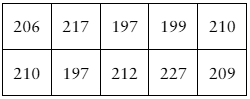
Reading Rates (See Problem 22 in Section 10.3.) Michael Sullivan, son of the author, decided to enroll in a reading course that allegedly increases reading speed and comprehension. Prior to enrolling in the course, Michael read 198 words per minute (wpm). The following data represent the words per minute read for 10 different passages after the course.

c. Generate 5000 independent bootstrap samples of size n=10 with replacement. For each bootstrap sample, determine the sample mean. That is, build a null model.
Verified step by step guidance1
Identify the original sample data, which consists of the words per minute (wpm) read for 10 passages after the course: 206, 217, 197, 199, 210, 210, 197, 212, 227, and 209.
Understand that a bootstrap sample is created by randomly selecting observations from the original sample with replacement, meaning each value can be chosen multiple times or not at all in a single bootstrap sample.
Generate 5000 independent bootstrap samples, each of size n = 10, by repeatedly sampling with replacement from the original 10 data points.
For each of these 5000 bootstrap samples, calculate the sample mean by summing the 10 values in the bootstrap sample and dividing by 10. The formula for the sample mean is:
\[\text{mean} = \frac{1}{n} \sum_{i=1}^{n} x_i\]
where \(x_i\) are the values in the bootstrap sample.
Collect all 5000 sample means to form the bootstrap distribution of the sample mean, which serves as the null model to understand the variability of the sample mean under the assumption that the original sample is representative of the population.
Verified video answer for a similar problem:This video solution was recommended by our tutors as helpful for the problem above
Video duration:
2mPlay a video:
0 Comments
Key Concepts
Here are the essential concepts you must grasp in order to answer the question correctly.
Bootstrap Sampling
Bootstrap sampling is a resampling technique used to estimate the sampling distribution of a statistic by repeatedly drawing samples with replacement from the observed data. It allows for assessing variability and constructing confidence intervals without relying on strict parametric assumptions.
Recommended video:
Sampling Distribution of Sample Proportion
Sample Mean
The sample mean is the average value of a set of observations and serves as an estimate of the population mean. In bootstrap methods, calculating the sample mean for each resampled dataset helps approximate the distribution of the mean under the null model.
Recommended video:
Sampling Distribution of Sample Mean
Null Model in Hypothesis Testing
A null model represents the assumption that there is no effect or difference, serving as a baseline for comparison. Generating bootstrap samples under the null model helps evaluate the variability of the statistic if the null hypothesis were true.
Recommended video:
Performing Hypothesis Tests: Proportions
Related Videos
Related Practice
Textbook Question
46
views