"In Exercises 13–18, test the claim about the difference between two population variances σ₁² and σ₂² at the level of significance α. Assume the samples are random and independent, and the populations are normally distributed.
Step 1: Understand the problem. The goal is to test the claim that the variance of population 1 (σ₁²) is greater than the variance of population 2 (σ₂²) using a significance level of α = 0.10. This involves conducting an F-test for comparing two variances.
Step 2: State the null and alternative hypotheses. The null hypothesis (H₀) is that the variances are equal: H₀: σ₁² = σ₂². The alternative hypothesis (H₁) is that the variance of population 1 is greater than the variance of population 2: H₁: σ₁² > σ₂².
Step 3: Calculate the test statistic. The formula for the F-test statistic is F = (s₁² / s₂²), where s₁² and s₂² are the sample variances. Substitute the given values: s₁² = 773 and s₂² = 765.
Step 4: Determine the degrees of freedom for each sample. For sample 1, degrees of freedom (df₁) = n₁ - 1 = 5 - 1 = 4. For sample 2, degrees of freedom (df₂) = n₂ - 1 = 6 - 1 = 5.
Step 5: Compare the calculated F-statistic to the critical value from the F-distribution table at α = 0.10 with df₁ = 4 and df₂ = 5. If the calculated F-statistic exceeds the critical value, reject the null hypothesis; otherwise, fail to reject the null hypothesis.
Verified video answer for a similar problem:
This video solution was recommended by our tutors as helpful for the problem above
Video duration:
3m
Play a video:
0 Comments
Key Concepts
Here are the essential concepts you must grasp in order to answer the question correctly.
Hypothesis Testing
Hypothesis testing is a statistical method used to make decisions about population parameters based on sample data. In this context, we formulate a null hypothesis (H0: σ₁² ≤ σ₂²) and an alternative hypothesis (H1: σ₁² > σ₂²) to test the claim regarding the variances. The outcome of the test will help determine if there is enough evidence to reject the null hypothesis in favor of the alternative.
The F-test is a statistical test used to compare the variances of two populations. It involves calculating the F-statistic, which is the ratio of the two sample variances (s₁²/s₂²). This statistic follows an F-distribution under the null hypothesis, and we compare it to a critical value from the F-distribution table based on the degrees of freedom to determine if the variances are significantly different.
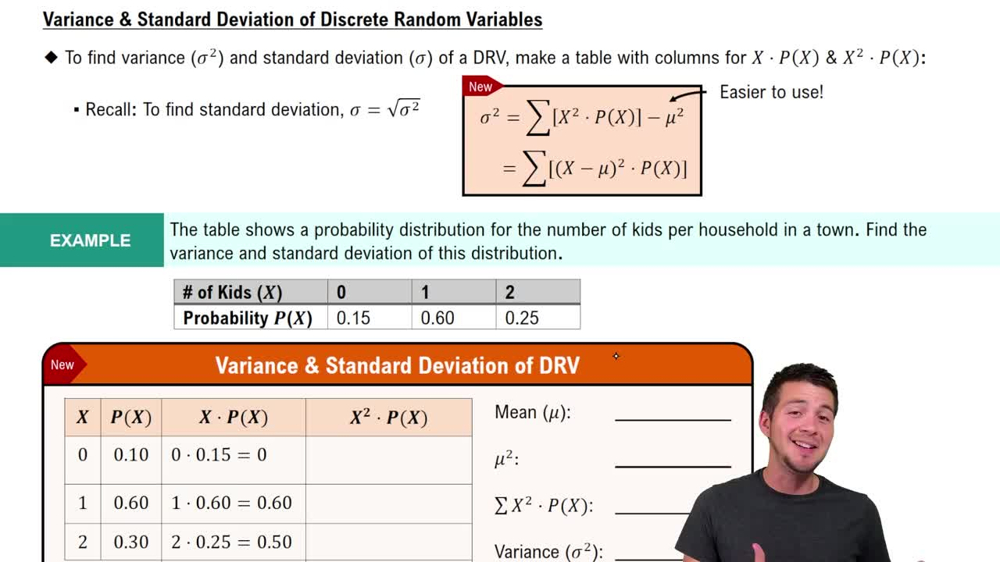
Variance & Standard Deviation of Discrete Random Variables
Level of Significance (α)
The level of significance, denoted as α, is the probability of rejecting the null hypothesis when it is actually true (Type I error). In this case, α is set at 0.10, meaning there is a 10% risk of concluding that σ₁² is greater than σ₂² when it is not. This threshold helps to determine the critical value for the F-test and guides the decision-making process in hypothesis testing.