Suppose that P(E) = 0.8, P(F) = 0.5, and P(E and F) = 0.24. Are events E and F independent? Why?
Table of contents
- 1. Intro to Stats and Collecting Data1h 14m
- 2. Describing Data with Tables and Graphs1h 55m
- 3. Describing Data Numerically2h 5m
- 4. Probability2h 16m
- 5. Binomial Distribution & Discrete Random Variables3h 6m
- 6. Normal Distribution and Continuous Random Variables2h 11m
- 7. Sampling Distributions & Confidence Intervals: Mean3h 23m
- Sampling Distribution of the Sample Mean and Central Limit Theorem19m
- Distribution of Sample Mean - Excel23m
- Introduction to Confidence Intervals15m
- Confidence Intervals for Population Mean1h 18m
- Determining the Minimum Sample Size Required12m
- Finding Probabilities and T Critical Values - Excel28m
- Confidence Intervals for Population Means - Excel25m
- 8. Sampling Distributions & Confidence Intervals: Proportion1h 25m
- 9. Hypothesis Testing for One Sample3h 57m
- 10. Hypothesis Testing for Two Samples4h 50m
- Two Proportions1h 13m
- Two Proportions Hypothesis Test - Excel28m
- Two Means - Unknown, Unequal Variance1h 3m
- Two Means - Unknown Variances Hypothesis Test - Excel12m
- Two Means - Unknown, Equal Variance15m
- Two Means - Unknown, Equal Variances Hypothesis Test - Excel9m
- Two Means - Known Variance12m
- Two Means - Sigma Known Hypothesis Test - Excel21m
- Two Means - Matched Pairs (Dependent Samples)42m
- Matched Pairs Hypothesis Test - Excel12m
- 11. Correlation1h 24m
- 12. Regression1h 50m
- 13. Chi-Square Tests & Goodness of Fit2h 21m
- 14. ANOVA1h 57m
4. Probability
Multiplication Rule: Independent Events
Struggling with Statistics?
Join thousands of students who trust us to help them ace their exams!Watch the first videoMultiple Choice
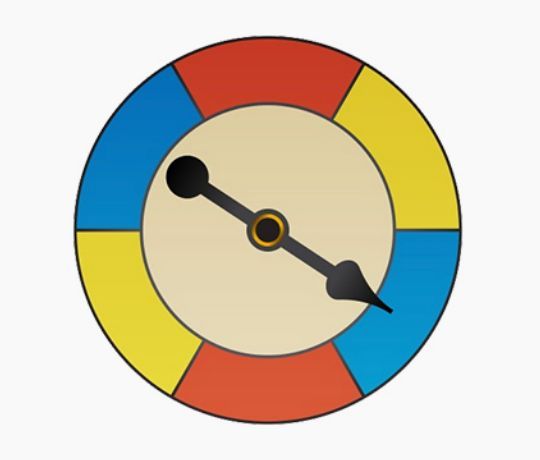
The spinner below has 6 equal regions. Find the probability of landing on yellow for the first spin and not landing on yellow on the second spin.

A
0.11
B
0.22
C
0.66
D
0.88
Verified step by step guidance1
Count the number of yellow regions on the spinner. There are 2 yellow regions out of a total of 6 regions.
Calculate the probability of landing on yellow for the first spin. This is the number of yellow regions divided by the total number of regions: \( \frac{2}{6} \).
Calculate the probability of not landing on yellow for the second spin. Since there are 4 non-yellow regions, the probability is \( \frac{4}{6} \).
Multiply the probability of landing on yellow on the first spin by the probability of not landing on yellow on the second spin: \( \frac{2}{6} \times \frac{4}{6} \).
Simplify the resulting fraction to find the final probability.
Watch next
Master Probability of Multiple Independent Events with a bite sized video explanation from Patrick
Start learningRelated Videos
Related Practice
Textbook Question
3
views
Multiplication Rule: Independent Events practice set

