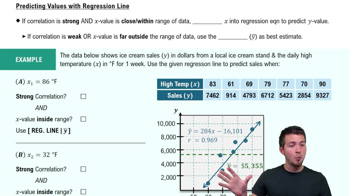
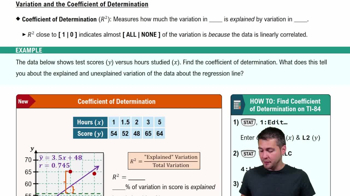
"Height versus Head Circumference Use the results of Problem 13 from Section 12.3 to answer the following questions: a. Predict the mean head circumference of children who are 25.75 inches tall."
Verified step by step guidance
1
Identify the regression equation from Problem 13 in Section 12.3, which should be in the form \(\hat{y} = b_0 + b_1 x\), where \(\hat{y}\) is the predicted head circumference and \(x\) is the height in inches.
Substitute the given height value, \(x = 25.75\), into the regression equation to find the predicted mean head circumference.
Calculate the predicted value by performing the multiplication and addition as indicated by the regression equation: \(\hat{y} = b_0 + b_1 \times 25.75\).
Interpret the result as the estimated average head circumference for children who are 25.75 inches tall.
If needed, check the units and context to ensure the prediction makes sense within the scope of the data and problem.
Verified video answer for a similar problem:
This video solution was recommended by our tutors as helpful for the problem above
Video duration:
3m
Play a video:
0 Comments
Key Concepts
Here are the essential concepts you must grasp in order to answer the question correctly.
Linear Regression
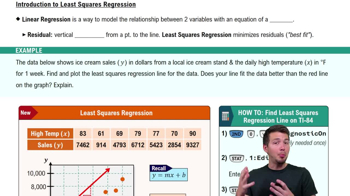
Linear regression models the relationship between two variables by fitting a straight line to observed data. It is used to predict the value of a dependent variable (e.g., head circumference) based on an independent variable (e.g., height). The regression equation typically has the form ŷ = b0 + b1x, where b0 is the intercept and b1 is the slope.
Prediction involves substituting a given value of the independent variable into the regression equation to estimate the mean value of the dependent variable. For example, to predict mean head circumference for a child 25.75 inches tall, plug 25.75 into the regression equation for height.
The slope coefficient (b1) indicates the average change in the dependent variable for each one-unit increase in the independent variable. The intercept (b0) represents the predicted value when the independent variable is zero. Understanding these helps interpret the relationship and make meaningful predictions.

 3:09 minutes
 Verified step by step guidance
 07:01
07:01