"Classifying Events as Independent or Dependent In Exercises 9-14, determine whether the events are independent or dependent. Explain your reasoning. 12. Not putting money in a parking meter and getting a parking ticket"
Verified step by step guidance
1
Understand the definition of independent and dependent events: Independent events are those where the occurrence of one event does not affect the probability of the other event. Dependent events are those where the occurrence of one event does affect the probability of the other event.
Analyze the scenario: The two events in question are (1) not putting money in a parking meter and (2) getting a parking ticket.
Consider the relationship between the events: If you do not put money in a parking meter, it increases the likelihood of getting a parking ticket. This suggests that the occurrence of the first event directly influences the probability of the second event.
Conclude the classification: Since the occurrence of not putting money in a parking meter affects the likelihood of getting a parking ticket, these events are dependent.
Explain the reasoning: The dependency arises because the action of not paying at the parking meter creates a situation where a parking ticket is more likely to be issued, showing a causal relationship between the two events.
Verified video answer for a similar problem:
This video solution was recommended by our tutors as helpful for the problem above
Video duration:
1m
Play a video:
0 Comments
Key Concepts
Here are the essential concepts you must grasp in order to answer the question correctly.
Independent Events
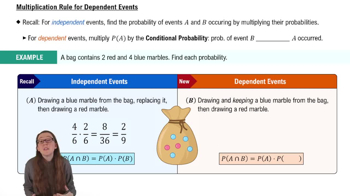
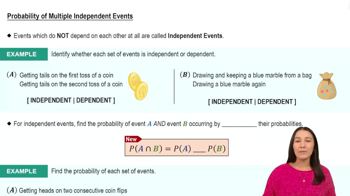
Independent events are those whose outcomes do not affect each other. In probability, two events A and B are independent if the occurrence of A does not change the likelihood of B occurring, and vice versa. For example, flipping a coin and rolling a die are independent events because the result of one does not influence the other.
Dependent events are those where the outcome of one event affects the outcome of another. In probability, events A and B are dependent if the occurrence of A changes the probability of B occurring. For instance, drawing cards from a deck without replacement creates dependent events, as the first draw alters the composition of the deck for subsequent draws.
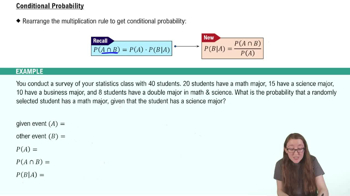
Conditional probability refers to the probability of an event occurring given that another event has already occurred. It is denoted as P(A|B), which represents the probability of event A occurring given that event B has occurred. Understanding conditional probability is crucial for determining whether events are dependent, as it helps assess how the occurrence of one event influences the likelihood of another.

 1:49 minutes
 Verified step by step guidance
 05:54
05:54