Happiness In a survey sponsored by Coca-Cola, subjects were asked what contributes most to their happiness, and the table summarizes their responses. Does the table represent a probability distribution? Explain.
Table of contents
- 1. Intro to Stats and Collecting Data1h 14m
- 2. Describing Data with Tables and Graphs1h 56m
- 3. Describing Data Numerically2h 5m
- 4. Probability2h 17m
- 5. Binomial Distribution & Discrete Random Variables3h 6m
- 6. Normal Distribution and Continuous Random Variables2h 11m
- 7. Sampling Distributions & Confidence Intervals: Mean3h 23m
- Sampling Distribution of the Sample Mean and Central Limit Theorem19m
- Distribution of Sample Mean - ExcelBonus23m
- Introduction to Confidence Intervals15m
- Confidence Intervals for Population Mean1h 18m
- Determining the Minimum Sample Size Required12m
- Finding Probabilities and T Critical Values - ExcelBonus28m
- Confidence Intervals for Population Means - ExcelBonus25m
- 8. Sampling Distributions & Confidence Intervals: Proportion2h 10m
- 9. Hypothesis Testing for One Sample5h 8m
- Steps in Hypothesis Testing1h 6m
- Performing Hypothesis Tests: Means1h 4m
- Hypothesis Testing: Means - ExcelBonus42m
- Performing Hypothesis Tests: Proportions37m
- Hypothesis Testing: Proportions - ExcelBonus27m
- Performing Hypothesis Tests: Variance12m
- Critical Values and Rejection Regions28m
- Link Between Confidence Intervals and Hypothesis Testing12m
- Type I & Type II Errors16m
- 10. Hypothesis Testing for Two Samples5h 37m
- Two Proportions1h 13m
- Two Proportions Hypothesis Test - ExcelBonus28m
- Two Means - Unknown, Unequal Variance1h 3m
- Two Means - Unknown Variances Hypothesis Test - ExcelBonus12m
- Two Means - Unknown, Equal Variance15m
- Two Means - Unknown, Equal Variances Hypothesis Test - ExcelBonus9m
- Two Means - Known Variance12m
- Two Means - Sigma Known Hypothesis Test - ExcelBonus21m
- Two Means - Matched Pairs (Dependent Samples)42m
- Matched Pairs Hypothesis Test - ExcelBonus12m
- Two Variances and F Distribution29m
- Two Variances - Graphing CalculatorBonus16m
- 11. Correlation1h 24m
- 12. Regression3h 33m
- Linear Regression & Least Squares Method26m
- Residuals12m
- Coefficient of Determination12m
- Regression Line Equation and Coefficient of Determination - ExcelBonus8m
- Finding Residuals and Creating Residual Plots - ExcelBonus11m
- Inferences for Slope31m
- Enabling Data Analysis ToolpakBonus1m
- Regression Readout of the Data Analysis Toolpak - ExcelBonus21m
- Prediction Intervals13m
- Prediction Intervals - ExcelBonus19m
- Multiple Regression - ExcelBonus29m
- Quadratic Regression15m
- Quadratic Regression - ExcelBonus10m
- 13. Chi-Square Tests & Goodness of Fit2h 21m
- 14. ANOVA2h 29m
5. Binomial Distribution & Discrete Random Variables
Binomial Distribution
Problem 5.CRE.2b
Textbook Question
Kentucky Pick 4 In the Kentucky Pick 4 lottery game, you can pay \$1 for a “straight” bet in which you select four digits with repetition allowed. If you buy only one ticket and win, your prize is \$2500.
b. If you play this game once every day, find the mean number of wins in years with exactly 365 days.
Verified step by step guidance1
Step 1: Understand the problem. The Kentucky Pick 4 lottery involves selecting four digits with repetition allowed, meaning each digit can range from 0 to 9. The total number of possible combinations is calculated as 10^4, since there are 10 choices for each of the 4 digits.
Step 2: Calculate the probability of winning. Since there is only one winning combination out of the total possible combinations, the probability of winning on a single ticket is given by P(win) = 1 / (10^4).
Step 3: Determine the number of days played in a year. The problem states that the game is played once every day in a year with 365 days. Therefore, the total number of games played in a year is 365.
Step 4: Use the formula for the mean number of wins. The mean number of wins in a given number of trials is calculated as μ = n * P(win), where n is the number of trials (365 days) and P(win) is the probability of winning on a single ticket.
Step 5: Substitute the values into the formula. Replace n with 365 and P(win) with 1 / (10^4) to compute the mean number of wins. The result will represent the expected number of wins in a year with 365 days.
Verified video answer for a similar problem:This video solution was recommended by our tutors as helpful for the problem above
Video duration:
2mPlay a video:
0 Comments
Key Concepts
Here are the essential concepts you must grasp in order to answer the question correctly.
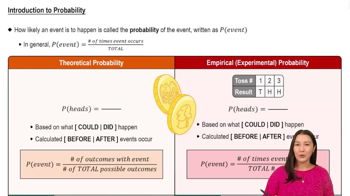
Probability
Probability is a measure of the likelihood that a particular event will occur, expressed as a number between 0 and 1. In the context of the Kentucky Pick 4 lottery, the probability of winning with a single ticket can be calculated based on the total number of possible combinations of four digits, considering that repetition is allowed.
Recommended video:
Introduction to Probability
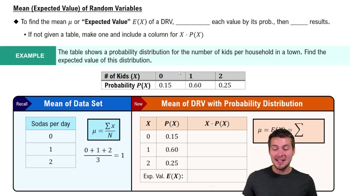
Expected Value
Expected value is a statistical concept that provides a measure of the center of a probability distribution, representing the average outcome if an experiment is repeated many times. In this lottery scenario, the expected number of wins over a year can be calculated by multiplying the probability of winning by the number of plays (365 days).
Recommended video:
Guided course
Expected Value (Mean) of Random Variables
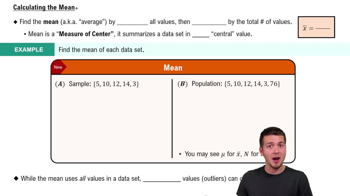
Mean
The mean, or average, is a fundamental statistical measure that summarizes a set of values by dividing the sum of those values by the number of values. In this case, the mean number of wins in a year can be derived from the expected value, indicating how many times a player can expect to win if they play the lottery daily.
Recommended video:
Guided course
Calculating the Mean
Related Videos
Related Practice
Textbook Question
80
views