
Textbook Question
"Graphical Analysis In Exercises 1–3, use the figure.
2. Describe the explained variation about a regression line in words and in symbols."
68
views

 Verified step by step guidance
 05:43
05:43
 07:09 05:43
"Graphical Analysis In Exercises 1–3, use the figure.
2. Describe the explained variation about a regression line in words and in symbols."
"In Exercises 7-12, match the description in the left column with its symbol(s) in the right column.
7. The y-value of a data point corresponding to x;
a. \(\hat{y}\)_i
b. y_i
c. b
d. (\(\bar{x}\), \(\bar{y}\))
e. m
f. \(\bar{y}\)"
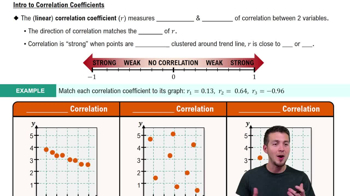
Graphical Analysis In Exercises 11–14, determine whether there is a perfect positive linear correlation, a strong positive linear correlation, a perfect negative linear correlation, a strong negative linear correlation, or no linear correlation between the variables.
"Constructing and Interpreting a Prediction Interval In Exercises 21-30, construct the indicated prediction interval and interpret the results.
21. Proceeds Construct a 95% prediction interval for the proceeds from initial public offerings in Exercise 11 when the number of offerings is 200."
"Constructing and Interpreting a Prediction Interval In Exercises 21-30, construct the indicated prediction interval and interpret the results.
27. Natural Gas Construct a 95% prediction interval for the export of natural gas from the United States in Exercise 17 when the marketed production of natural gas in the United States is 31 trillion cubic feet."
"Old Vehicles In Exercises 31–34, use the figure shown at the left.
Scatter Plot Construct a scatter plot of the data. Show y and x on the graph."