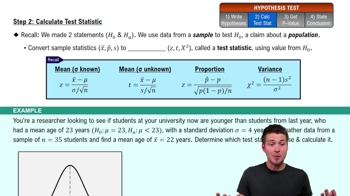
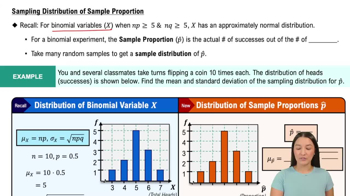
Describe the test statistic for the sign test when the sample size n is less than or equal to 25 and when n is greater than 25.
Verified step by step guidance
1
Understand the sign test: The sign test is a non-parametric test used to determine whether there is a significant difference between paired observations or whether a median of a single sample differs from a hypothesized value. It is based on the signs (+ or -) of the differences rather than their magnitudes.
For sample size n ≤ 25: When the sample size is small (n ≤ 25), the test statistic is the count of the number of positive signs (or negative signs, depending on the hypothesis). This count is compared to the binomial distribution, as the signs follow a binomial distribution with parameters n and p = 0.5 under the null hypothesis.
For sample size n > 25: When the sample size is large (n > 25), the binomial distribution can be approximated by a normal distribution using the Central Limit Theorem. The test statistic is standardized using the formula: , where X is the count of positive signs, n is the sample size, and p = 0.5.
Interpret the test statistic: For n ≤ 25, the test statistic is directly compared to critical values from the binomial distribution table. For n > 25, the Z-score is compared to critical values from the standard normal distribution to determine significance.
Summarize the decision rule: Based on the calculated test statistic and the chosen significance level (α), decide whether to reject or fail to reject the null hypothesis. For small samples, use the binomial distribution; for large samples, use the normal approximation.
Verified video answer for a similar problem:
This video solution was recommended by our tutors as helpful for the problem above
Video duration:
3m
Play a video:
0 Comments
Key Concepts
Here are the essential concepts you must grasp in order to answer the question correctly.
Sign Test
The sign test is a non-parametric statistical method used to determine if there is a significant difference between the median of a sample and a hypothesized value. It is particularly useful when the sample size is small or when the data does not meet the assumptions of normality required for parametric tests. The test counts the number of positive and negative differences from the median, allowing for a straightforward analysis of the data.
In the context of the sign test, the test statistic is derived from the number of positive and negative signs in the sample data. For small sample sizes (n ≤ 25), the test statistic follows a binomial distribution, which can be used to calculate the p-value directly. For larger sample sizes (n > 25), the distribution of the test statistic can be approximated using a normal distribution, allowing for easier computation of significance levels.
The sample size plays a crucial role in determining the appropriate method for calculating the test statistic in the sign test. For n ≤ 25, exact binomial probabilities are used, making the test more sensitive to small sample variations. Conversely, for n > 25, the central limit theorem allows the use of normal approximation, which simplifies calculations but may reduce sensitivity to small differences in the data.

 3:43 minutes
 Verified step by step guidance
 06:28
06:28