Comparing Standard Deviations The standard deviation of batting averages of all teams in the American League is 0.008. The standard deviation of all players in the American League is 0.02154. Why is there less variability in team batting averages?
Verified step by step guidance
1
Understand what standard deviation measures: it quantifies the amount of variation or dispersion in a set of data values.
Recognize that team batting averages are averages of individual players' batting averages, so each team average is a mean of several player averages.
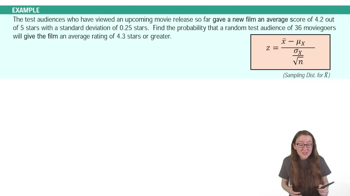
Recall that when you average multiple values, the variability (standard deviation) of those averages tends to be smaller than the variability of the individual values themselves, due to the averaging effect smoothing out extremes.
This phenomenon is related to the concept of the standard error of the mean, which is calculated as \(\frac{\sigma}{\sqrt{n}}\), where \(\sigma\) is the standard deviation of individual observations and \(n\) is the number of observations averaged.
Therefore, the standard deviation of team batting averages is less than that of individual players because each team average combines multiple player averages, reducing overall variability.
Verified video answer for a similar problem:
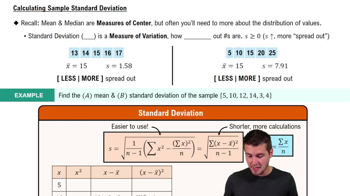
This video solution was recommended by our tutors as helpful for the problem above
Video duration:
12m
Play a video:
0 Comments
Key Concepts
Here are the essential concepts you must grasp in order to answer the question correctly.
Standard Deviation
Standard deviation measures the amount of variation or dispersion in a set of values. A smaller standard deviation indicates that the data points are closer to the mean, while a larger one shows more spread. It helps quantify variability within a dataset, such as batting averages.
When individual data points are averaged to form group-level data, variability tends to decrease. This is because individual fluctuations can cancel out, leading to more stable averages. Thus, team batting averages, being averages of many players, show less variability than individual player averages.
Within-group variability refers to differences among individuals in the same group, while between-group variability refers to differences between group averages. Individual players vary widely, but when grouped into teams, the variability between team averages is smaller due to the averaging of individual performances.