The General Social Survey regularly asks individuals to disclose their religious affiliation. The following data represent the religious affiliation of young adults, aged 18 to 29, in the 1970s, 1980s, 1990s, and 2000s. Do the data suggest different proportions of 18- to 29-year-olds have been affiliated with religion in the past four decades? Use the α = 0.05 level of significance.
Verified step by step guidance
1
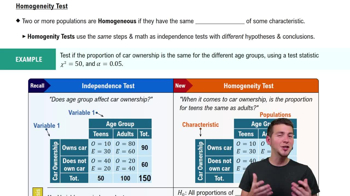
Identify the type of test needed: Since we want to compare proportions of religious affiliation across four different decades, we will use a Chi-Square Test for Homogeneity to see if the distribution of religious affiliation differs by decade.
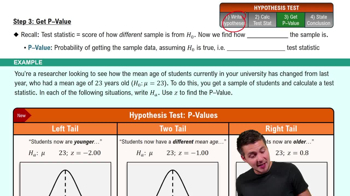
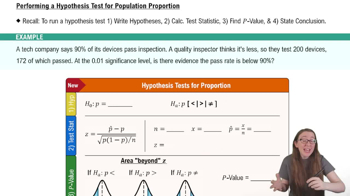
Set up the hypotheses: The null hypothesis \(H_0\) states that the proportions of young adults affiliated with religion are the same across all four decades. The alternative hypothesis \(H_a\) states that at least one decade has a different proportion.
Organize the data into a contingency table with rows representing the decades (1970s, 1980s, 1990s, 2000s) and columns representing religious affiliation categories (e.g., affiliated, not affiliated).
Calculate the expected counts for each cell of the table under the assumption that the null hypothesis is true. The formula for the expected count in each cell is:
\[\text{Expected Count} = \frac{(\text{Row Total}) \times (\text{Column Total})}{\text{Grand Total}}\]
Compute the Chi-Square test statistic using the formula:
\[\chi^2 = \sum \frac{(\text{Observed Count} - \text{Expected Count})^2}{\text{Expected Count}}\]
Then, determine the degrees of freedom as \((\text{number of rows} - 1) \times (\text{number of columns} - 1)\), and compare the test statistic to the critical value from the Chi-Square distribution with the given significance level \(\alpha = 0.05\) to decide whether to reject or fail to reject the null hypothesis.
Verified video answer for a similar problem:
This video solution was recommended by our tutors as helpful for the problem above
Video duration:
8m
Play a video:
0 Comments
Key Concepts
Here are the essential concepts you must grasp in order to answer the question correctly.
Hypothesis Testing for Proportions
Hypothesis testing for proportions involves comparing observed sample proportions to determine if there is a statistically significant difference between groups or over time. In this context, it tests whether the proportion of young adults affiliated with religion differs across decades, using null and alternative hypotheses.
The chi-square test for homogeneity assesses whether different populations (or groups) have the same distribution of a categorical variable. Here, it evaluates if the proportions of religious affiliation among young adults are consistent across the four decades, based on observed and expected counts.
The significance level (α = 0.05) is the threshold for deciding whether to reject the null hypothesis. The p-value measures the probability of observing the data if the null hypothesis is true. If the p-value is less than α, it suggests a significant difference in proportions across decades.

 8:46 minutes
 Verified step by step guidance
 05:52
05:52