Religion in Congress Is the religious make-up of the United States Congress reflective of that in the general population? The following table shows the religious affiliation of the 535 members of the 116th Congress along with the religious affiliation of a random sample of 1200 adult Americans. a. Determine the probability distribution for the religious affiliation of the members of the 116th Congress.
Verified step by step guidance
1
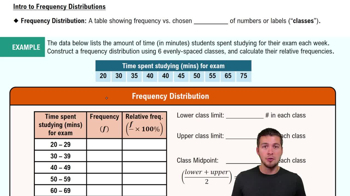
Step 1: Understand that the probability distribution for the religious affiliation of the members of the 116th Congress is found by calculating the relative frequency of each religion category. This means dividing the number of members in each category by the total number of members (535).
Step 2: For each religion category, use the formula for probability: \(P(\text{Religion}) = \frac{\text{Number of Members in that Religion}}{535}\).
Step 3: Apply this formula to each category in the table. For example, for Protestants, calculate \(P(\text{Protestant}) = \frac{293}{535}\).
Step 4: Repeat the calculation for all other categories: Catholic, Mormon, Orthodox Christian, Jewish, Buddhist/Muslim/Hindu/Other, and Unaffiliated/Don't Know/Refused.
Step 5: After calculating these probabilities, verify that the sum of all probabilities equals 1 (or very close due to rounding), confirming a valid probability distribution.
Verified video answer for a similar problem:
This video solution was recommended by our tutors as helpful for the problem above
Video duration:
2m
Play a video:
0 Comments
Key Concepts
Here are the essential concepts you must grasp in order to answer the question correctly.
Probability Distribution
A probability distribution lists all possible outcomes of a random variable along with their probabilities. For categorical data like religious affiliation, it shows the proportion of each category relative to the total. Calculating it involves dividing the count of each category by the total number of observations.
Calculating Probabilities in a Binomial Distribution
Relative Frequency
Relative frequency is the ratio of the number of times a specific event occurs to the total number of trials or observations. It serves as an empirical estimate of probability and is used to construct probability distributions from observed data, such as the religious affiliations in Congress.
Comparative analysis involves examining two or more probability distributions to identify similarities or differences. In this context, comparing the religious affiliation distribution of Congress members to that of the general population helps assess representativeness or bias.