World Series Are the teams that play in the World Series evenly matched? To win a World Series, a team must win four games. If the teams are evenly matched, we would expect the number of games played in the World Series to follow the distribution shown in the first two columns of the following table. The third column represents the actual number of games played in each World Series from 1930 to 2019. Do the data support the distribution that would exist if the teams are evenly matched and the outcome of each game is independent? Use the α = 0.05 level of significance.
Table of contents
- 1. Intro to Stats and Collecting Data1h 14m
- 2. Describing Data with Tables and Graphs1h 56m
- 3. Describing Data Numerically2h 5m
- 4. Probability2h 17m
- 5. Binomial Distribution & Discrete Random Variables3h 6m
- 6. Normal Distribution and Continuous Random Variables2h 11m
- 7. Sampling Distributions & Confidence Intervals: Mean3h 23m
- Sampling Distribution of the Sample Mean and Central Limit Theorem19m
- Distribution of Sample Mean - ExcelBonus23m
- Introduction to Confidence Intervals15m
- Confidence Intervals for Population Mean1h 18m
- Determining the Minimum Sample Size Required12m
- Finding Probabilities and T Critical Values - ExcelBonus28m
- Confidence Intervals for Population Means - ExcelBonus25m
- 8. Sampling Distributions & Confidence Intervals: Proportion2h 10m
- 9. Hypothesis Testing for One Sample5h 8m
- Steps in Hypothesis Testing1h 6m
- Performing Hypothesis Tests: Means1h 4m
- Hypothesis Testing: Means - ExcelBonus42m
- Performing Hypothesis Tests: Proportions37m
- Hypothesis Testing: Proportions - ExcelBonus27m
- Performing Hypothesis Tests: Variance12m
- Critical Values and Rejection Regions28m
- Link Between Confidence Intervals and Hypothesis Testing12m
- Type I & Type II Errors16m
- 10. Hypothesis Testing for Two Samples5h 37m
- Two Proportions1h 13m
- Two Proportions Hypothesis Test - ExcelBonus28m
- Two Means - Unknown, Unequal Variance1h 3m
- Two Means - Unknown Variances Hypothesis Test - ExcelBonus12m
- Two Means - Unknown, Equal Variance15m
- Two Means - Unknown, Equal Variances Hypothesis Test - ExcelBonus9m
- Two Means - Known Variance12m
- Two Means - Sigma Known Hypothesis Test - ExcelBonus21m
- Two Means - Matched Pairs (Dependent Samples)42m
- Matched Pairs Hypothesis Test - ExcelBonus12m
- Two Variances and F Distribution29m
- Two Variances - Graphing CalculatorBonus16m
- 11. Correlation1h 24m
- 12. Regression3h 33m
- Linear Regression & Least Squares Method26m
- Residuals12m
- Coefficient of Determination12m
- Regression Line Equation and Coefficient of Determination - ExcelBonus8m
- Finding Residuals and Creating Residual Plots - ExcelBonus11m
- Inferences for Slope31m
- Enabling Data Analysis ToolpakBonus1m
- Regression Readout of the Data Analysis Toolpak - ExcelBonus21m
- Prediction Intervals13m
- Prediction Intervals - ExcelBonus19m
- Multiple Regression - ExcelBonus29m
- Quadratic Regression15m
- Quadratic Regression - ExcelBonus10m
- 13. Chi-Square Tests & Goodness of Fit2h 21m
- 14. ANOVA2h 29m
13. Chi-Square Tests & Goodness of Fit
Goodness of Fit Test
Problem 11.1.8
Textbook Question
In Exercises 5–20, conduct the hypothesis test and provide the test statistic and the P-value and/or critical value, and state the conclusion.
Flat Tire and Missed Class A classic story involves four carpooling students who missed a test and gave as an excuse a flat tire. On the makeup test, the instructor asked the students to identify the particular tire that went flat. If they really didn’t have a flat tire, would they be able to identify the same tire? The author asked 41 other students to identify the tire they would select. The results are listed in the following table (except for one student who selected the spare). Use a 0.05 significance level to test the author’s claim that the results fit a uniform distribution. What does the result suggest about the likelihood of four students identifying the same tire when they really didn’t have a flat?

Verified step by step guidance1
Step 1: Define the null and alternative hypotheses. The null hypothesis (H₀) states that the tire selections follow a uniform distribution, meaning each tire is equally likely to be selected. The alternative hypothesis (H₁) states that the tire selections do not follow a uniform distribution.
Step 2: Calculate the expected frequency for each tire under the assumption of a uniform distribution. Since there are 41 students and 4 tires, the expected frequency for each tire is calculated as: .
Step 3: Use the observed frequencies from the table (11 for Left Front, 15 for Right Front, 8 for Left Rear, and 6 for Right Rear) and the expected frequencies to compute the test statistic. The test statistic for a chi-square goodness-of-fit test is calculated using the formula: , where O represents the observed frequency and E represents the expected frequency.
Step 4: Determine the degrees of freedom for the chi-square test. The degrees of freedom are calculated as: , where k is the number of categories (in this case, 4 tires).
Step 5: Compare the calculated test statistic to the critical value from the chi-square distribution table at a significance level of 0.05, or use the P-value approach. If the test statistic exceeds the critical value or if the P-value is less than 0.05, reject the null hypothesis. Otherwise, fail to reject the null hypothesis. Interpret the result in the context of the problem to determine the likelihood of four students identifying the same tire when they really didn’t have a flat.
Verified video answer for a similar problem:This video solution was recommended by our tutors as helpful for the problem above
Video duration:
4mPlay a video:
0 Comments
Key Concepts
Here are the essential concepts you must grasp in order to answer the question correctly.
Hypothesis Testing
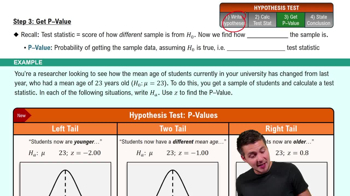
Hypothesis testing is a statistical method used to make decisions about a population based on sample data. It involves formulating a null hypothesis (H0) that represents no effect or no difference, and an alternative hypothesis (H1) that indicates the presence of an effect. The test assesses the evidence against H0 using a test statistic and a significance level, leading to a conclusion about whether to reject or fail to reject H0.
Recommended video:
Guided course
Step 1: Write Hypotheses
Uniform Distribution
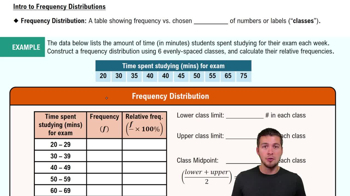
A uniform distribution is a type of probability distribution where all outcomes are equally likely. In the context of this question, testing for a uniform distribution means evaluating whether the selection of tires by the students is evenly distributed across the available options. If the results significantly deviate from what would be expected under a uniform distribution, it suggests that the selections are not random and may indicate a bias or pattern.
Recommended video:
Guided course
Intro to Frequency Distributions
P-value
The P-value is a measure that helps determine the strength of the evidence against the null hypothesis in hypothesis testing. It represents the probability of observing the test results, or something more extreme, assuming that the null hypothesis is true. A smaller P-value indicates stronger evidence against H0, and if it is less than the predetermined significance level (e.g., 0.05), the null hypothesis is rejected, suggesting that the observed data is unlikely under the null hypothesis.
Recommended video:
Guided course
Step 3: Get P-Value
Related Videos
Related Practice
Textbook Question
36
views