
In a certain hypothesis test, , < . You collect a sample and calculate a test statistic . Find the -value.
Table of contents
- 1. Intro to Stats and Collecting Data1h 14m
- 2. Describing Data with Tables and Graphs1h 56m
- 3. Describing Data Numerically2h 5m
- 4. Probability2h 17m
- 5. Binomial Distribution & Discrete Random Variables3h 6m
- 6. Normal Distribution and Continuous Random Variables2h 11m
- 7. Sampling Distributions & Confidence Intervals: Mean3h 23m
- Sampling Distribution of the Sample Mean and Central Limit Theorem19m
- Distribution of Sample Mean - ExcelBonus23m
- Introduction to Confidence Intervals15m
- Confidence Intervals for Population Mean1h 18m
- Determining the Minimum Sample Size Required12m
- Finding Probabilities and T Critical Values - ExcelBonus28m
- Confidence Intervals for Population Means - ExcelBonus25m
- 8. Sampling Distributions & Confidence Intervals: Proportion2h 10m
- 9. Hypothesis Testing for One Sample5h 8m
- Steps in Hypothesis Testing1h 6m
- Performing Hypothesis Tests: Means1h 4m
- Hypothesis Testing: Means - ExcelBonus42m
- Performing Hypothesis Tests: Proportions37m
- Hypothesis Testing: Proportions - ExcelBonus27m
- Performing Hypothesis Tests: Variance12m
- Critical Values and Rejection Regions28m
- Link Between Confidence Intervals and Hypothesis Testing12m
- Type I & Type II Errors16m
- 10. Hypothesis Testing for Two Samples5h 37m
- Two Proportions1h 13m
- Two Proportions Hypothesis Test - ExcelBonus28m
- Two Means - Unknown, Unequal Variance1h 3m
- Two Means - Unknown Variances Hypothesis Test - ExcelBonus12m
- Two Means - Unknown, Equal Variance15m
- Two Means - Unknown, Equal Variances Hypothesis Test - ExcelBonus9m
- Two Means - Known Variance12m
- Two Means - Sigma Known Hypothesis Test - ExcelBonus21m
- Two Means - Matched Pairs (Dependent Samples)42m
- Matched Pairs Hypothesis Test - ExcelBonus12m
- Two Variances and F Distribution29m
- Two Variances - Graphing CalculatorBonus16m
- 11. Correlation1h 24m
- 12. Regression3h 33m
- Linear Regression & Least Squares Method26m
- Residuals12m
- Coefficient of Determination12m
- Regression Line Equation and Coefficient of Determination - ExcelBonus8m
- Finding Residuals and Creating Residual Plots - ExcelBonus11m
- Inferences for Slope31m
- Enabling Data Analysis ToolpakBonus1m
- Regression Readout of the Data Analysis Toolpak - ExcelBonus21m
- Prediction Intervals13m
- Prediction Intervals - ExcelBonus19m
- Multiple Regression - ExcelBonus29m
- Quadratic Regression15m
- Quadratic Regression - ExcelBonus10m
- 13. Chi-Square Tests & Goodness of Fit2h 21m
- 14. ANOVA2h 29m
9. Hypothesis Testing for One Sample
Steps in Hypothesis Testing
Problem 8.1.6a
Textbook Question
Identifying H0 and H1
In Exercises 5–8, do the following:
a. Express the original claim in symbolic form.
b. Identify the null and alternative hypotheses.
Light Year Claim: Most adults know that a light year is a measure of distance. Sample data: A Pew Research Center survey of 3278 adults showed that 72% knew that a light year is a measure of distance.
Verified step by step guidance1
Step 1: Understand the problem. The claim is that 'most adults know that a light year is a measure of distance.' In statistical terms, 'most' typically means more than 50%. This will guide us in formulating the hypotheses.
Step 2: Express the original claim in symbolic form. Let p represent the proportion of adults who know that a light year is a measure of distance. The claim 'most adults' translates to p > 0.5.
Step 3: Identify the null hypothesis (H0). The null hypothesis is the statement that there is no effect or no difference, and it is often the complement of the claim. Here, H0: p ≤ 0.5.
Step 4: Identify the alternative hypothesis (H1). The alternative hypothesis represents the claim being tested. Since the claim is that 'most adults' know this fact, H1: p > 0.5.
Step 5: Summarize the hypotheses. The null hypothesis is H0: p ≤ 0.5, and the alternative hypothesis is H1: p > 0.5. These hypotheses will be tested using the sample data provided (72% of 3278 adults).
Verified video answer for a similar problem:This video solution was recommended by our tutors as helpful for the problem above
Video duration:
2mPlay a video:
0 Comments
Key Concepts
Here are the essential concepts you must grasp in order to answer the question correctly.
Null Hypothesis (H0)
The null hypothesis (H0) is a statement that indicates no effect or no difference, serving as a default position in hypothesis testing. It is often formulated to be tested against an alternative hypothesis. In this context, H0 might state that the proportion of adults who know that a light year is a measure of distance is equal to a certain value, such as 50%.
Recommended video:
Guided course
Step 1: Write Hypotheses
Alternative Hypothesis (H1)
The alternative hypothesis (H1) represents the statement that there is an effect or a difference, opposing the null hypothesis. It is what researchers aim to support through their data. For the light year claim, H1 could assert that the proportion of adults who understand that a light year measures distance is greater than 50%, reflecting the original claim.
Recommended video:
Guided course
Step 1: Write Hypotheses
Symbolic Representation
Symbolic representation in statistics involves expressing hypotheses using mathematical symbols. This allows for clear communication of the hypotheses being tested. For example, if p represents the proportion of adults who know what a light year is, the symbolic forms could be H0: p = 0.50 and H1: p > 0.50, succinctly capturing the claims being evaluated.
Recommended video:
Guided course
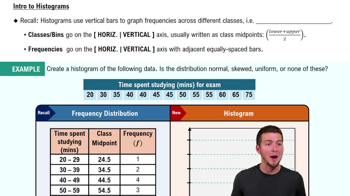
Intro to Histograms
Related Videos
Related Practice
Multiple Choice
293
views
4
rank
