In Exercises 69 and 70, determine whether you can use a normal distribution to approximate the binomial distribution. If you can, use the normal distribution to approximate the indicated probabilities and sketch their graphs. If you cannot, explain why and use a binomial distribution to find the indicated probabilities.
A survey of U.S. adults found that 72% used a mobile device to manage their bank account at least once in the previous month. You randomly select 70 U.S. adults and ask whether they used a mobile device to manage their bank account at least once in the previous month. Find the probability that the number who have done so is (a) at most 40.
Verified step by step guidance
1
Step 1: Verify if the normal distribution can be used to approximate the binomial distribution. Check the conditions: (1) The sample size (n) should be large, and (2) both np and n(1-p) should be greater than or equal to 5. Here, n = 70 and p = 0.72. Calculate np = 70 * 0.72 and n(1-p) = 70 * (1 - 0.72).
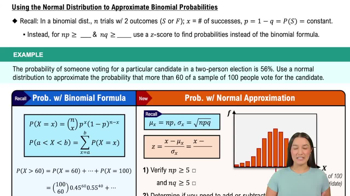
Step 2: If the conditions are satisfied, proceed to approximate the binomial distribution using the normal distribution. The mean (μ) and standard deviation (σ) of the binomial distribution are given by μ = np and σ = sqrt(np(1-p)). Calculate these values using the given n and p.
Step 3: Convert the binomial probability 'at most 40' into a z-score for the normal distribution. Use the continuity correction by adjusting the value to 40.5 (since we are approximating a discrete distribution with a continuous one). The z-score formula is z = (x - μ) / σ, where x is the adjusted value.
Step 4: Use the z-score to find the cumulative probability from the standard normal distribution table or a statistical software. This will give the probability that the number of adults who used a mobile device to manage their bank account is at most 40.
Step 5: Sketch the graph of the normal distribution curve, marking the mean (μ) at the center and shading the area to the left of the z-score corresponding to 40.5. This shaded area represents the probability you calculated.
Verified video answer for a similar problem:

This video solution was recommended by our tutors as helpful for the problem above
Video duration:
12m
Play a video:
0 Comments
Key Concepts
Here are the essential concepts you must grasp in order to answer the question correctly.
Binomial Distribution
The binomial distribution models the number of successes in a fixed number of independent Bernoulli trials, each with the same probability of success. In this context, it applies to the survey of U.S. adults, where each adult either uses a mobile device to manage their bank account (success) or does not (failure). The parameters of the binomial distribution are the number of trials (n) and the probability of success (p).
Mean & Standard Deviation of Binomial Distribution
Normal Approximation to the Binomial
The normal approximation to the binomial distribution is used when the number of trials is large, and both np and n(1-p) are greater than 5. This allows us to use the normal distribution to estimate probabilities for binomial outcomes, simplifying calculations. In this case, we check if the conditions are met to approximate the binomial distribution of mobile device usage with a normal distribution.
Using the Normal Distribution to Approximate Binomial Probabilities
Probability Calculation
Probability calculation involves determining the likelihood of a specific outcome occurring within a defined set of possibilities. For the given problem, we need to calculate the probability that at most 40 out of 70 adults used a mobile device to manage their bank account. This can be done using either the binomial formula or the normal approximation, depending on whether the approximation conditions are satisfied.