A frequency distribution lists the _____of occurrences of each category of data, while a relative frequency distribution lists the______of occurrences of each category of data.
Table of contents
- 1. Intro to Stats and Collecting Data1h 14m
- 2. Describing Data with Tables and Graphs1h 56m
- 3. Describing Data Numerically2h 5m
- 4. Probability2h 17m
- 5. Binomial Distribution & Discrete Random Variables3h 6m
- 6. Normal Distribution and Continuous Random Variables2h 11m
- 7. Sampling Distributions & Confidence Intervals: Mean3h 23m
- Sampling Distribution of the Sample Mean and Central Limit Theorem19m
- Distribution of Sample Mean - ExcelBonus23m
- Introduction to Confidence Intervals15m
- Confidence Intervals for Population Mean1h 18m
- Determining the Minimum Sample Size Required12m
- Finding Probabilities and T Critical Values - ExcelBonus28m
- Confidence Intervals for Population Means - ExcelBonus25m
- 8. Sampling Distributions & Confidence Intervals: Proportion2h 10m
- 9. Hypothesis Testing for One Sample5h 8m
- Steps in Hypothesis Testing1h 6m
- Performing Hypothesis Tests: Means1h 4m
- Hypothesis Testing: Means - ExcelBonus42m
- Performing Hypothesis Tests: Proportions37m
- Hypothesis Testing: Proportions - ExcelBonus27m
- Performing Hypothesis Tests: Variance12m
- Critical Values and Rejection Regions28m
- Link Between Confidence Intervals and Hypothesis Testing12m
- Type I & Type II Errors16m
- 10. Hypothesis Testing for Two Samples5h 37m
- Two Proportions1h 13m
- Two Proportions Hypothesis Test - ExcelBonus28m
- Two Means - Unknown, Unequal Variance1h 3m
- Two Means - Unknown Variances Hypothesis Test - ExcelBonus12m
- Two Means - Unknown, Equal Variance15m
- Two Means - Unknown, Equal Variances Hypothesis Test - ExcelBonus9m
- Two Means - Known Variance12m
- Two Means - Sigma Known Hypothesis Test - ExcelBonus21m
- Two Means - Matched Pairs (Dependent Samples)42m
- Matched Pairs Hypothesis Test - ExcelBonus12m
- Two Variances and F Distribution29m
- Two Variances - Graphing CalculatorBonus16m
- 11. Correlation1h 24m
- 12. Regression3h 33m
- Linear Regression & Least Squares Method26m
- Residuals12m
- Coefficient of Determination12m
- Regression Line Equation and Coefficient of Determination - ExcelBonus8m
- Finding Residuals and Creating Residual Plots - ExcelBonus11m
- Inferences for Slope31m
- Enabling Data Analysis ToolpakBonus1m
- Regression Readout of the Data Analysis Toolpak - ExcelBonus21m
- Prediction Intervals13m
- Prediction Intervals - ExcelBonus19m
- Multiple Regression - ExcelBonus29m
- Quadratic Regression15m
- Quadratic Regression - ExcelBonus10m
- 13. Chi-Square Tests & Goodness of Fit2h 21m
- 14. ANOVA2h 29m
2. Describing Data with Tables and Graphs
Frequency Distributions
Problem 2.1.14d
Textbook Question
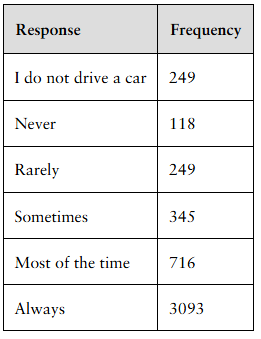
"College Survey In a national survey conducted by the Centers for Disease Control to determine health-risk behaviors among college students, college students were asked, “How often do you wear a seat belt when driving a car?” The frequencies were as follows:

d. Construct a frequency bar graph."
Verified step by step guidance1
Step 1: Identify the categories and their corresponding frequencies from the table. Here, the categories are the responses: "I do not drive a car", "Never", "Rarely", "Sometimes", "Most of the time", and "Always". Their frequencies are 249, 118, 249, 345, 716, and 3093 respectively.
Step 2: Draw the axes for the bar graph. Label the horizontal axis (x-axis) with the response categories and the vertical axis (y-axis) with the frequency values. Make sure to choose an appropriate scale for the y-axis that can accommodate the highest frequency (3093).
Step 3: For each response category on the x-axis, draw a bar whose height corresponds to the frequency of that category. For example, the bar for "Never" should reach up to 118 on the y-axis, and the bar for "Always" should reach up to 3093.
Step 4: Ensure that the bars are evenly spaced and have the same width. Each bar should be clearly labeled or color-coded if desired, to distinguish the categories easily.
Step 5: Add a title to the bar graph, such as "Frequency of Seat Belt Use Among College Students", and label the axes clearly (e.g., "Response" for the x-axis and "Frequency" for the y-axis). This will make the graph informative and easy to understand.
Verified video answer for a similar problem:This video solution was recommended by our tutors as helpful for the problem above
Video duration:
4mPlay a video:
0 Comments
Key Concepts
Here are the essential concepts you must grasp in order to answer the question correctly.
Frequency Distribution
A frequency distribution is a summary of data that shows the number of observations within each category or group. It helps organize raw data into a more understandable form, making it easier to analyze patterns or trends. In this question, the frequency distribution lists how many students fall into each seat belt usage category.
Recommended video:
Guided course
Intro to Frequency Distributions
Bar Graph Construction
A bar graph visually represents categorical data with rectangular bars, where the length of each bar corresponds to the frequency of each category. It is useful for comparing different groups at a glance. To construct a bar graph here, each response category will be on the x-axis, and the frequency on the y-axis.
Recommended video:
Creating Bar Graphs and Pareto Charts
Categorical Data
Categorical data represents variables that can be divided into distinct groups or categories, such as responses to a survey question. These categories are qualitative and often non-numeric, requiring specific methods like bar graphs for visualization. Understanding the nature of categorical data is essential for choosing the right graphical representation.
Recommended video:
Introduction to Collecting Data
Related Videos
Related Practice
Textbook Question
51
views