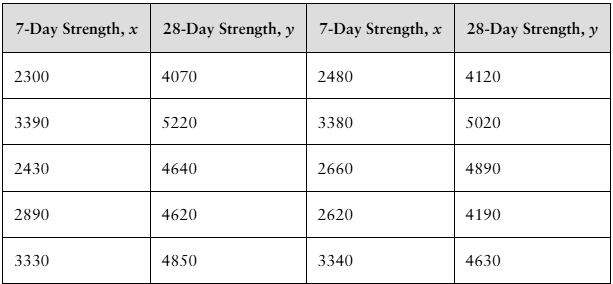
[DATA] Concrete [See Problem 15 in Section 12.3] As concrete cures, it gains strength. The following data represent the 7-day and 28-day strength (in pounds per square inch) of a certain type of concrete: d. State your conclusion to the hypotheses from part (b).
Verified step by step guidance
1
Recall the hypotheses from part (b), which typically involve testing whether there is a significant linear relationship between the 7-day strength (x) and the 28-day strength (y) of the concrete. The null hypothesis \(H_0\) usually states that the slope \(\beta_1 = 0\) (no linear relationship), and the alternative hypothesis \(H_a\) states that \(\beta_1 \neq 0\) (there is a linear relationship).
Use the data provided to calculate the regression line of the form \(y = \beta_0 + \beta_1 x\), where \(x\) is the 7-day strength and \(y\) is the 28-day strength. This involves computing the slope \(\beta_1\) and intercept \(\beta_0\) using formulas:
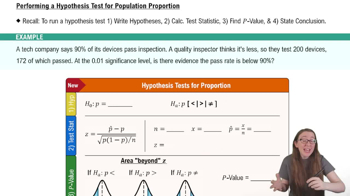
Perform a hypothesis test on the slope \(\beta_1\) by calculating the test statistic (usually a t-statistic) and comparing it to the critical value or using the p-value approach. The test statistic is:
\[ t = \frac{\hat{\beta}_1 - 0}{SE(\hat{\beta}_1)} \]
Based on the test statistic and significance level (commonly \(\alpha = 0.05\)), decide whether to reject or fail to reject the null hypothesis. Then, state your conclusion clearly in the context of the problem, indicating whether there is sufficient evidence to conclude a linear relationship between 7-day and 28-day concrete strength.
Verified video answer for a similar problem:
This video solution was recommended by our tutors as helpful for the problem above
Video duration:
1m
Play a video:
0 Comments
Key Concepts
Here are the essential concepts you must grasp in order to answer the question correctly.
Hypothesis Testing
Hypothesis testing is a statistical method used to decide whether there is enough evidence to reject a null hypothesis in favor of an alternative hypothesis. It involves setting up hypotheses, calculating a test statistic, and comparing it to a critical value or p-value to draw conclusions about the population.
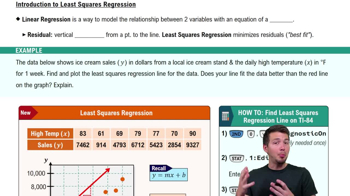
Linear regression models the relationship between a dependent variable and one or more independent variables by fitting a linear equation. In this context, it helps predict 28-day concrete strength based on 7-day strength, and the regression results inform hypothesis testing about the relationship.
Interpreting statistical results involves understanding what the outcomes of tests and models imply about the data and hypotheses. This includes stating conclusions clearly, such as whether to reject or fail to reject the null hypothesis, and explaining the practical significance of the findings.